Heads up: this post contains affiliate links. If you click through and make a purchase, we may earn a small commission at no extra cost to you — it’s how we keep the lights on and keep publishing free content. We only link to products we’d actually recommend to a friend.
A social-media feed can turn an ordinary drink into a “natural” version of a prescription medication before breakfast. That can leave people wondering whether a TikTok weight loss hack has real support or just a catchy promise. This article checks five popular ideas against what their ingredients can reasonably do: oatzempic, the gelatin trick, chia seed water, citrus or vinegar drinks, and GLP-1 foods. Checking means evaluating claims against evidence, not personally trying the hacks.
A familiar food ingredient is not automatically a proven weight-loss treatment. Satiety is the feeling of fullness after eating that can reduce the immediate desire to eat. Some foods and drinks may support satiety or add useful nutrition, but that does not make them miracle drinks or medication substitutes. The same distinction matters when social media promotes Lazy weight loss hacks as easy fixes for health concerns.
Key Takeaways
No food or drink can reproduce GLP-1 medications.
Oats and other fiber-rich foods may support fullness.
Temporary appetite relief is not the same as sustained weight loss.
Restrictive challenges are not balanced meal plans.
Check a trend’s promised results before changing how you eat.
Actively track your health and fitness with the Fitbit Google Air, an Amazon best-seller and a leader in screen less health tracking. Connects to your phone via BlueTooth and works via the Google Health app. Get yours using the link above.
Affiliate Disclosure: This page contains affiliate links. If you purchase through one of these links, we may earn a commission at no additional cost to you. We only recommend products and services we believe may provide value to our readers.
The following claim-by-claim assessment separates plausible nutrition benefits from promises that go too far, starting with the standard every trend should meet.
Do TikTok Weight Loss Hack, GLP-1 Foods, Miracle Drinks, Lazy Weight Loss Hacks Hold Up?
No viral food or drink hack can reproduce prescription GLP-1 medications. A plausible ingredient may support fullness or add nutrients, but the headline claim still needs evidence. That distinction helps separate a useful food from a supposed shortcut.
None of these trends is proven to cause rapid weight loss or act like medication. A drink can still be nutritious even when its weight-loss claim is unsupported. That difference matters: people can enjoy a food for its flavor or nutrients without expecting it to deliver a medical effect.
A nutritious ingredient does not prove a trend’s weight-loss promise, and no drink replaces prescription GLP-1 medications.
Trend
What people claim
Evidence-based takeaway
Oatzempic
A blended oats drink is a weight-loss shortcut.
Oats may support fullness, but the drink is not proven to cause rapid weight loss or mimic medication.
The gelatin trick
A drink before meals curbs appetite.
It may create brief fullness, but it is not a proven rapid-loss method or medication substitute.
Chia seed water
It keeps people full and leads to weight loss.
Chia adds fiber, but fullness does not prove rapid weight loss or a medication-like effect.
Citrus or vinegar drinks
They burn fat or boost metabolism.
They may add flavor, but they are not proven fat burners or medication substitutes.
GLP-1 foods
Some foods work like natural GLP-1 medications.
Nutritious foods can support a balanced diet, but they do not replicate prescription treatment.
In practice, a food’s nutrient content and a trend’s promised result are separate questions. A fiber-rich ingredient can contribute to a satisfying meal without producing the same effect as a prescription drug. The name GLP-1 foods does not change that distinction.
Oatzempic is the first claim to examine closely because its appeal rests on an ordinary ingredient and a dramatic challenge. Other appetite and drink trends make similar promises, though their ingredients and effects differ.
What Does the Oatzempic Trend Actually Do?
An ordinary oat-based breakfast drink can be one part of breakfast; a challenge that replaces meals is a different and riskier idea. Oatzempic may help some people feel full because oats contain soluble fiber, which slows digestion. That modest effect is not proof of rapid weight loss.
Oatzempic is not a meal replacement or a balanced diet. Whether it is added to breakfast or used instead of a meal changes what else a person eats that day. A drink can fit into a meal, but relying on it in place of varied foods may leave the routine incomplete.
What goes into the drink, and why can it feel filling?
Oatzempic is made with oats, lime juice, and water, with cinnamon sometimes added. A half-cup of oats with lime, water, and cinnamon is about 150 calories. The drink’s calorie count is not a special measure of its weight-loss power; it is simply one part of the food’s nutrition.
Soluble fiber in oats absorbs water and slows digestion, which can support fullness after eating. That may make an oat drink or oatmeal satisfying for some people. Oats also offer a familiar breakfast option, but the effect depends on the whole meal and a person’s appetite.
Adding the drink to breakfast is not the same as treating it as breakfast. A balanced meal can include other foods that provide protein and additional nutrients. A single drink does not supply everything someone needs across the day, so it should not become a stand-in for varied meals.
Why the two-month challenge is not a meal plan
A social-media challenge claimed that oatzempic and intermittent fasting could lead to 40 pounds of weight loss in two months. That is far above the commonly stated sustainable pace of about 1-2 pounds per week, or about 8-16 pounds over two months. The challenge’s 40-pound promise is not a safe target to treat as a plan.
Intermittent fasting does not make that promise reliable. Pairing a restricted eating schedule with a drink as a meal replacement can make it harder to get enough variety and nutrition. A routine built around an extreme target can also be difficult to keep up over time.
Can oatzempic speed metabolism? There is little scientific evidence that the recommended amount of lime juice speeds metabolism. Lime juice can add tart flavor, but it does not turn an oat drink into a metabolism treatment or explain the challenge’s dramatic claim.
The more realistic point is that oats may contribute fiber and fullness as part of a meal, while the drink itself is not a weight-loss prescription. The gelatin drink also leans on temporary fullness, though it works differently from an oat-based breakfast.
Can Gelatin and Other Miracle Drinks Curb Appetite?
Gelatin and other drinks may ease appetite briefly, but temporary fullness is not sustained weight loss. A gelatin drink before a meal can create a sense of fullness for around 30 minutes. Brief relief does not mean the drink burns fat or replaces food.
Gelatin is an incomplete protein and contains no fiber. A serving of plain, unflavored gelatin typically has about 2-4 grams of protein and 5-20 calories. Those figures describe the ingredient, not a complete snack or a proven weight-loss treatment.
What the gelatin trick can and cannot do
The gelatin trick commonly means drinking gelatin mixed with warm water about 15-30 minutes before a meal. Its volume and texture may temporarily help someone feel fuller, but that feeling can fade. The drink does not provide the fiber found in many filling foods.
Large amounts of gelatin can upset the stomach, and a gelatin drink should not replace food. A meal needs more than a temporary fullness cue. People who want something before a meal can choose a snack with more staying power, such as:
Nuts or seeds
Greek yogurt or cottage cheese
Beans or berries
A glass of water
Chia, citrus, and vinegar drinks are not fat burners
Chia seed water may feel filling because seeds absorb water and add fiber. A drink’s volume can also make the stomach feel temporarily full. Those effects do not show that it burns fat or causes a lasting change in weight.
Citrus and vinegar drinks can add flavor to water or a meal, but they are not proven fat burners. A tart drink does not selectively use body fat, and a metabolism claim should not be confused with a demonstrated treatment. The same caution applies to miracle drinks built around familiar foods.
Hunger is a normal signal, not a problem that every drink needs to silence. For some people, water before a meal is useful; for others, a snack with protein, fiber, or both may feel more satisfying. A practical choice can depend on appetite and what fits comfortably into the day.
Instead of trying to suppress appetite with drinks, people can build a balanced routine around choices that are easier to repeat. Low-effort habits can support that routine without promising a fast or guaranteed result.
Which Low-Effort Weight Habits Are Worth Keeping?
Adding a familiar protein-rich food to lunch can take less effort than following a restrictive challenge. Sustainable habits are more useful for weight management than a special drink because they can fit into ordinary routines. Small choices may support a balanced pattern without becoming another all-or-nothing rule.
Lasting weight management depends on habits a person can sustain. A calorie deficit can result from overall eating patterns, not from one special drink. How much a person eats and moves over time matters more than a viral ingredient presented as a shortcut.
A useful habit is one a person can keep repeating, not a restrictive rule built around a viral promise.
There is no single routine that suits everyone, and these options are flexible strategies, not a prescription or a guaranteed outcome. People can adjust them to their schedule, preferences, and appetite. Four low-friction choices may help make daily eating and activity more manageable:
Include protein and fiber-rich foods in meals.
Drink water before a meal if that feels helpful.
Keep tempting snacks less visible or less accessible.
Add everyday movement, such as walking or taking the stairs.
Protein and fiber can make meals more satisfying, while water can be an easy choice when someone wants a drink. A walk or a flight of stairs adds movement without requiring a formal workout. These behaviors do not need to happen perfectly to be part of a routine.
Changing the surroundings can also make a choice easier. Keeping snacks out of sight may reduce how often they catch someone’s attention, while keeping nourishing foods easy to reach can support a meal plan. The point is to make a preferred choice simpler, not to ban every treat.
Aggressively restricting food to copy a trend can make a routine difficult to sustain. If a plan depends on ignoring hunger or replacing balanced meals, it may be a poor fit for everyday life. Flexible habits leave room for different foods and changing schedules.
People can start with one adjustment and see whether it works in their actual day. Weight management is not guaranteed by any one behavior, and progress can vary. A useful next step is to ask whether a viral claim promises rapid results or requires restrictive eating before accepting its headline.
Conclusion
No miracle drink offers a shortcut equivalent to medication or sustainable habits. Fiber-rich foods and protein can be part of a satisfying diet, but foods and drinks do not mimic GLP-1 medications. A trend can still include nutritious ingredients without delivering the result its headline promises.
Before trying a new claim, check whether it promises rapid results or asks people to replace balanced meals. That simple test can help separate a reasonable food choice from a risky shortcut. Anyone considering medication or major dietary changes should discuss options with a qualified health professional.
FAQ
How to lose 2kg in 7 days?
Losing 2 kilograms in seven days is not a target to recommend as a routine goal. A commonly stated sustainable pace is about 1-2 pounds per week, and individual needs vary. A slower pace may be more manageable than a rapid-loss challenge. Avoid treating a social-media promise as a personal plan, especially if it requires skipping balanced meals.
What is the Japanese trick to losing weight?
There is no single established Japanese trick that causes weight loss. Claims about one secret method often simplify a much wider mix of food choices, daily movement, and personal routines. Repeatable eating and activity habits are a more useful focus than searching for a hidden technique. A habit should fit someone’s life and support a balanced overall pattern.
What are the four Japanese ingredients to lose weight?
No set of four ingredients is proven to cause weight loss. Foods associated with a cuisine can provide nutrients and fit into meals, but they are not treatments simply because they are grouped together. Weight management depends on an overall pattern rather than a fixed ingredient list. Be cautious when a trend assigns a guaranteed result to a few foods.
What are the 5 superfoods to burn belly fat?
No food selectively burns belly fat. Foods sometimes called superfoods can provide fiber, protein, vitamins, or other nutrients, and they may fit into an overall eating pattern. They cannot target fat loss in one body area. A balanced routine is a more realistic approach than expecting a handful of ingredients to change a specific part of the body.
What 3 foods to drop to lose weight?
There is no universal set of three foods everyone must eliminate to lose weight. A fixed ban list can be difficult to maintain and may not fit someone’s needs or preferences. Sustainable weight management focuses on overall intake and repeatable choices, not a rule that treats certain foods as forbidden for every person. A flexible pattern can include a range of foods.
What kills lower belly fat fast?
Nothing can reliably kill lower belly fat fast, and spot reduction is not realistic. Exercise or a particular food cannot direct the body to lose fat from only one area. Weight management concerns the overall body and can vary from person to person. Be wary of products or challenges that promise an instant change to a specific body part.
How can I mimic Ozempic naturally?
Food cannot replicate prescription GLP-1 medications. Protein- and fiber-rich foods may support fullness as part of a satisfying diet, but they are not medication substitutes. A drink promoted as a natural version does not provide the same treatment. Anyone considering medication or a major change to their diet should discuss options with a qualified health professional.
Heads up: this post contains affiliate links. If you click through and make a purchase, we may earn a small commission at no extra cost to you — it’s how we keep the lights on and keep publishing free content. We only link to products we’d actually recommend to a friend.
Your first strength training session may begin with a pause in front of a pair of dumbbells. You want to get stronger, build muscle, or simply feel more confident, but you are not sure which weight to choose. That hesitation is common, especially when a beginner workout seems to assume you already know what you are doing.
You can start safely at home without a crowded gym or a complicated setup. Begin with manageable weights, sound form, and a repeatable plan. This article shares general fitness information, not individualized medical advice, so adapt the ideas to your needs and seek professional guidance when appropriate.
Some beginners worry about bulking before they have even tried a dumbbell workout. Others wonder whether they have enough time, the right equipment, or the fitness to begin. You do not need to solve every question before your first session. Practical choices matter more than making the setup look impressive.
Key Takeaways
Start with a small, repeatable full-body plan.
Choose weights that let you control each repetition.
Two or three well-spaced sessions can be a manageable start.
Progress gradually, and stop a set when your form slips.
Bulking is an optional goal, not a requirement for getting stronger.
Adjust exercises to your space, comfort, and experience.
Lifting at home? Get your own set of Amazon Basics Hex Dumbbells here! You can get a full workout in with dumbbells, especially to get started, though we also recommend having a kettlebell as another essential piece for your home gym. Get your own Amazon Basics Kettlebell here!
Affiliate Disclosure: This page contains affiliate links. If you purchase through one of these links, we may earn a commission at no additional cost to you. We only recommend products and services we believe may provide value to our readers.
You will find decisions you can use in your next session, from selecting equipment to adapting a movement. A realistic picture of beginner progress makes those choices easier, so start with what early success can actually look and feel like.
What Should a Beginner Expect From Lifting at Home?
A useful first month is about better control and consistency, not being wiped out after every workout. Clean, repeatable movement is a stronger early sign than exhaustion, and your first goal is learning to perform the basic patterns with control.
At first, progress may mean remembering how to position your feet, keeping your balance, or repeating a movement without rushing. You may also feel more capable as familiar exercises become less awkward. Those are real signs that your body is learning, even if your appearance has not changed.
Early success means practicing controlled movement consistently, not finishing every workout exhausted.
Visible change and strength gains vary from person to person. They depend on many things, including your starting point, training habits, rest, and everyday life. There is no set timeline that fits everyone, so give yourself room to learn rather than measuring each workout against a calendar.
A beginner mistake is judging an exercise session only by soreness the next day. Muscles can feel tender after unfamiliar work, but soreness does not prove that a workout was effective. A session can help you learn and build consistency without leaving you sore or struggling through the day.
Notice how each movement feels while you do it. You should be able to pay attention to your position and repeat the exercise with similar control. If every set becomes a test of endurance, it may be harder to learn the movement or return for another session.
Clear priorities help you avoid copying plans designed for experienced lifters. A high-volume routine can look appealing online, but beginner needs are different. Choosing a plan that fits your experience starts with understanding what a beginner workout should include and what advanced formats can wait.
Strength Training, Beginner Workout, Dumbbell Workout, Home Workout, Bulking: Where to Begin
A beginner should start with a small, repeatable full-body plan, not the most demanding routine she can find. Practice comes first, and a few basic movement patterns are enough to make a useful starting point.
Whole-body training lets you practice movements that use several muscle groups without splitting each workout into a long list of body-part exercises. A strength goal may focus on handling more resistance or doing more controlled reps over time. A bulking goal puts more emphasis on gaining muscle and body weight, but it does not require entirely different exercises.
Set a goal that matches your starting point
Choose a goal you can connect to your current routine. You might want to learn the lifts, feel steadier carrying groceries, or build muscle. Each goal can begin with manageable workouts, a few sets, and careful attention to how you move.
Progressive overload means gradually increasing a training challenge over time so your body has a reason to adapt. That challenge can change in more than one way. You do not need to chase a heavier weight before you can control the reps you already do.
Avoid copying an advanced split
A new lifter does not need a high-volume body-part split, where one day focuses on chest and another on arms. Those workouts can add more sets and exercises than you need to learn the basics. A simple full-body approach is easier to repeat and adjust.
If you are returning after a long break, start below the amount a familiar workout plan prescribes. Your memory of past training does not guarantee that your current body is ready for the same workload. Let your present control and energy guide your starting point.
Once your goals and plan fit your experience, consider what will fit your available space and current strength. The right equipment makes a home routine practical without turning a corner of your room into a full gym.
How Should You Choose Home Dumbbells?
You can begin with bodyweight exercises or one suitable pair of dumbbells; you do not need a full home gym. Useful equipment is enough, and the right choice is the option you can use safely in your space.
Different exercises call for different loads. One heavy pair might feel useful for your legs but overwhelm your shoulders during a press. Adjustable dumbbells let you change the weight, while fixed-weight dumbbells are ready to use but offer no adjustment.
Equipment option
Space and adjustment
Best use
Main limitation
Bodyweight only
Minimal space; no load adjustment
Learning movement patterns without dumbbells
Some exercises offer limited loading choices
One fixed-weight pair
Small storage area; one set weight
Simple home workout with a suitable pair
That weight may not suit every exercise
Adjustable dumbbells
One storage area; load can be changed
Several exercises needing different weights
Changing settings takes time between movements
Choose a load for how it feels during controlled reps, not for how impressive it looks on the floor. A weight that makes you twist, rush, or lose your position is not a useful starting challenge. Smaller dumbbells can be the better choice for upper-body work.
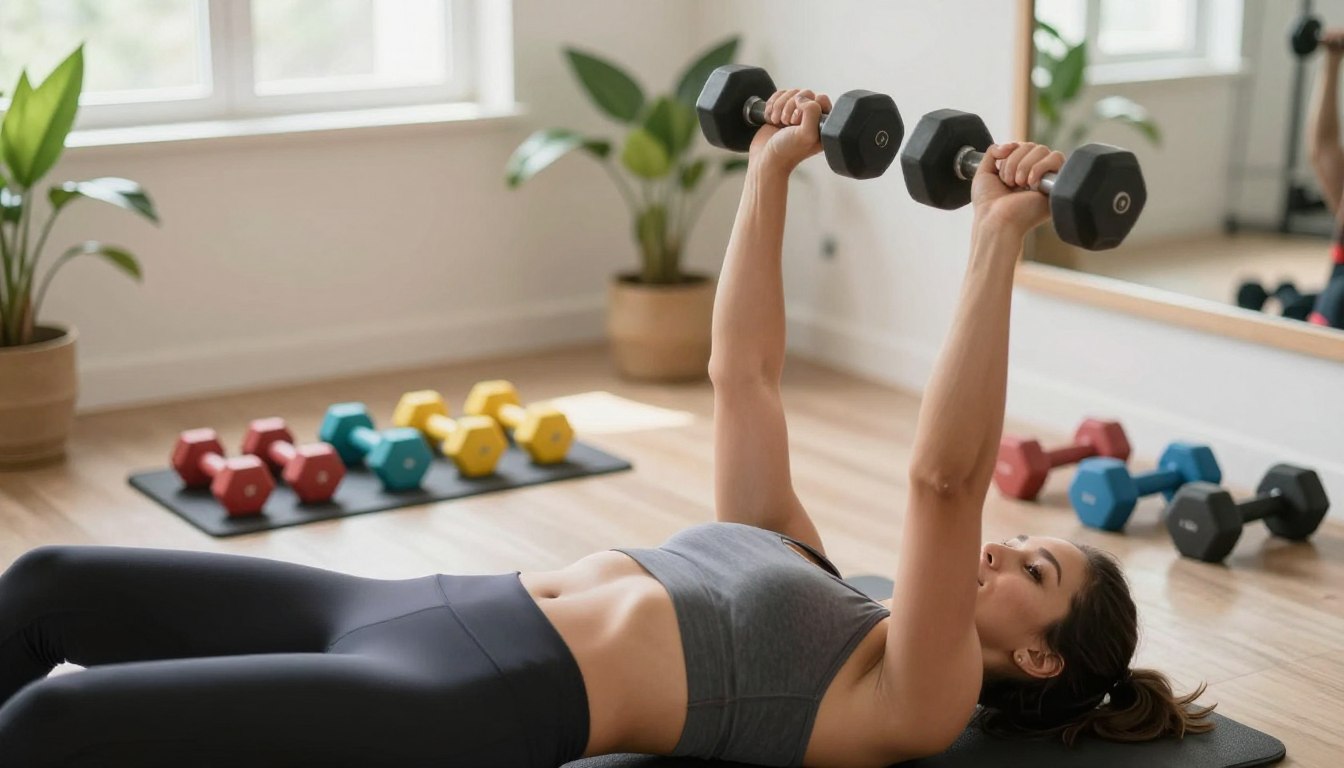
A bench is optional. You can do the floor-press variation lying on the floor, which supports your arms at the bottom of the movement. Keep the path around you clear, especially if you need to put the weights down between exercises.
Check the dumbbells before you use them, and store adjustable pieces as their instructions describe. You do not need to buy every size at once. Start with equipment that suits the exercises you plan to practice and the room you have available.
Once your choice is set, prepare your body and your floor space. A brief, movement-specific warm-up can make the first working set feel more controlled than jumping straight into working weight.
What Warm-Up and Setup Prevent Avoidable Mistakes?
On a first session, a few minutes of comfortable movement can help the first set feel more controlled than starting with working weight immediately. Prepare for the movements ahead, and keep the warm-up comfortable rather than forcing a stretch or position.
Use this short sequence as a guide. Move smoothly, breathe normally, and shorten a movement if it feels uncomfortable. A band is optional; you can skip that step if you do not have one.
Prepare the joints and movements you will use
Hold a hip-flexor stretch for 30-60 seconds per side.
Do five deep-lunge hip circles per leg.
In a deep lunge, reach through five thoracic rotations per side.
Complete five downward-dog walk-outs.
Do 10 band shoulder dislocates if a band is available.
Complete 20 lunges with an overhead reach.
Make the workout area safe
Look over the floor before you pick up the weights. Choose stable flooring that does not slide or shift under your feet. Clear a path around your starting position so you can move without stepping over clutter or furniture.
Place dumbbells where they will not roll into your work area. Keep them within reach, but not where your feet need to land. If you use adjustable dumbbells, check that each handle and weight plate is secured before lifting.
Your hands should have a clear grip, and your feet should have room to settle into a comfortable position. Set up a mat only if it stays flat and does not slide. A tidy floor is a practical part of the exercise setup, not a cosmetic extra.
Take a moment to check the space again when you change positions. The path that was clear while standing might be blocked once you lie down for a floor exercise. With your body and room ready, the next concern is avoiding form errors that can undermine otherwise sensible lifts.
Which Form Errors Make Common Lifts Less Safe?
A bent-over row can turn into a rounded-back tug when the dumbbell feels too heavy. Reduce the load first, then hinge only as far as you can while keeping a flat back; stop a set when you cannot maintain your position.
During a hinge, let your hips travel back while your spine stays neutral. Avoid rounding your lower back to reach farther down. Your comfortable range may be shorter than someone else’s, and it does not need to match an arbitrary depth.
During a press, keep your elbows from flaring excessively out to the sides. Find a comfortable path that lets you control the dumbbells. If your elbows drift too far or your shoulders feel awkward, reduce the load and adjust the position.
Rushing the lowering phase can make it harder to stay in control. Bend elbows and lower the dumbbells smoothly instead of letting gravity pull them down. A steady descent gives you time to notice whether your position is changing.
In a squat, notice whether your weight shifts onto your toes. Keep your feet grounded and your movement balanced rather than letting your heels lift. The depth should be comfortable and controlled, not forced to meet a target that does not suit your current mobility.
Use a mirror only if it helps you see a clear position without distracting you. You can also pause briefly between reps and reset. Stop the set if you cannot keep your back, elbows, or feet in a controlled position.
Even good technique needs enough recovery between sessions. A sensible weekly frequency gives your muscles time away from lifting and helps you make the routine repeatable rather than exhausting.
How Many Days Should a Beginner Train Each Week?
Two or three well-spaced full-body sessions a week are a sensible starting point for many beginners. Leave room to recover, with a rest day between lifting sessions; Monday, Wednesday, and Friday is one workable three-day example.
Recovery is part of training, not time you need to earn. A rest day lets you return with more attention to movement and effort. If your schedule only allows two sessions, that can still give you regular chances to practice and build strength.
Advanced formats are not the beginner default. One plan uses three 30-minute AMRAP sessions with jumps, while another uses four weekly body-part workouts, six exercises, and three supersets per session. Those are different demands, and a beginner does not need that starting volume.
AMRAP means doing as many rounds as possible during a set time. A jump-based circuit can be a poor fit if you have not built landing control or want low-impact training. You can learn basic movement patterns without adding jumps or racing against a clock.
Pay attention to how you feel between sessions. If fatigue keeps disrupting your form or makes it hard to complete ordinary tasks, take more recovery time or reduce the work. Your plan should fit your life, not require you to rearrange everything around it.
Choose a weekly rhythm you can return to, then keep the sessions focused. A simple, repeatable full-body workout can cover major muscle groups with a small group of familiar movements.
What Does a Simple Full-Body Dumbbell Workout Look Like?
A small set of compound dumbbell movements can train your whole body at home. Keep the menu simple, and choose exercises that cover your chest, back, shoulders, legs, and core without requiring a large setup.
Dumbbell workouts at home can be practical because one pair supports several movement patterns. Start with a version you can control, and use a lighter load or reduce the range when your position becomes uncertain.
Cover the major movement patterns with five exercises
Exercise
Main areas worked
Simple form cue
Beginner adjustment
Dumbbell floor press
Chest, shoulders, arms
Lower elbows gently until upper arms meet the floor
Use a lighter load or press one dumbbell at a time
Bent-over row
Back, biceps, core
Hinge with a flat back and draw elbows toward your ribs
Use a lighter load or hinge less deeply
Goblet squat
Legs, hips, core
Hold one dumbbell close and keep feet grounded
Squat without weight or use a shorter range
Romanian deadlift
Back of legs, hips, back
Send hips back while keeping dumbbells near your legs
Use lighter dumbbells and stop before your back rounds
Overhead press
Shoulders, arms, core
Press upward without leaning your lower back
Use a lighter load or press one arm at a time
Scale the session to your current ability
These exercises offer a starting framework, not a test. Omit or replace a move that causes pain rather than pushing through it. Choose a range and load that let you repeat the movement with control.
You can find a free strength training beginner workout by looking for clear demonstrations, beginner options, and safe form cues. A free beginner workout, dumbbell workout, or home workout does not have to come from a paid program. Look for bulking guidance that treats nutrition as an individual choice, not a requirement to lift.
Check whether the person teaching a movement explains how to scale it and what position to watch. A video can help you learn, but it cannot see your form or account for a personal health concern. Keep the exercises that feel manageable and leave room to learn.
With the movement choices set, decide how many reps and sets to start with and how long to rest. A manageable dose gives you a way to practice without turning each exercise into a race.
How Heavy Should Dumbbells Feel, and How Many Reps Should You Do?
The right load challenges the final reps without making you change the movement to finish them. Controlled effort is the goal, and a useful starting point is three sets of 8-12 reps per exercise, with 60 seconds of rest between sets.
If three sets compromise your form or recovery, begin with fewer. Your dumbbell weight can differ from one exercise to another because a load that feels manageable in one movement may be too heavy in another.
The final repetitions should feel challenging while staying controlled. Reps in reserve means the number of good repetitions you believe you could still do before your form breaks down. Leave a few in reserve as you learn how a set should feel.
What happens in the set
What it tells you
Next step
Controlled reps with a few left
The load may suit your current ability
Keep the weight and build steady practice
Target reps become sloppy
The load or effort is too demanding
Stop the set and reduce the challenge
Target reps remain easy across sessions
You may be ready for more challenge
Build reps first, then consider a small increase
Do not force every set to reach the top of the range if control fades. A clean set with fewer repetitions is more useful for learning than extra reps that involve swinging or losing your position.
Rest for about 60 seconds between sets as a starting point. Take longer if you need it to regain control and focus before the next set. The clock can guide you, but your ability to perform the next set well matters more.
Once a load and set feel manageable, you have a starting challenge to build gradually over time. Progress does not mean adding weight every time you exercise.
How Can You Progress Without Adding Weight Every Session?
If eight clean reps become 12 clean reps at the same load, you have a clear reason to consider the next small increase. Earn the change with control, and do not add weight before you can manage your current reps steadily.
Progressive overload can mean gradually making a workout more challenging in a way you can recover from. Log what you did, then use the record to decide whether to repeat the same effort or adjust it. A small change is easier to judge than several changes at once.
Log the load and the clean reps you completed.
Build toward the top of your planned rep range.
Add a small amount of weight only when your form stays steady.
If heavier dumbbells are unavailable and recovery is good, lower the weight more slowly or add a set.
One four-week dumbbell program moves from four sets of 10 reps in week one to four sets of 12 in week two. It then moves to five sets of 10 in week three and five sets of 12 in week four, while changing tempo in later weeks.
That program is an example of progression, not a required beginner template. It changes both the work and the tempo, so you do not need to copy it exactly. A small, steady adjustment that suits your equipment and recovery can be a better fit.
Do not treat a missed target as a reason to force the next increase. Repeat the same load until you can complete the planned reps cleanly, or reduce the challenge if your movement changes. Your notes can help you spot those patterns instead of guessing.
Exercise provides the growth stimulus, while food and recovery support your body’s adaptation. That connection leads to a common next question: what should you eat if building muscle is one of your goals?
What Should Women Eat to Build Muscle?
Regular, balanced meals with enough protein support training, and a calorie surplus is only needed if you choose to prioritize weight gain. Bulking is optional, and your calorie needs depend on your body, activity, and goals.
A broad starting range for someone choosing to bulk is 300-500 extra calories per day above maintenance. That is not a promise of a particular result or a prescription for everyone. Your needs differ, and a surplus is not required just to do strength workouts.
Use a modest calorie surplus if bulking is the goal
A commonly used protein target is about 0.8-1 gram per pound of body weight per day. Personal needs and medical circumstances vary, so treat that range as general guidance rather than a rule you must meet exactly. Your regular meals can help you build a practical pattern.
Make protein and recovery part of the plan
Include a protein source in meals.
Choose familiar foods such as eggs, yogurt, beans, tofu, fish, or poultry.
Pair meals with carbohydrates to support training energy.
Track body-weight trends over time instead of reacting to one weigh-in.
There is no need to make every meal complicated. Familiar foods can make it easier to eat consistently, while carbohydrates can help fuel exercise. Notice how your energy and recovery feel alongside your training rather than focusing on one number alone.
Scale readings can shift from day to day. A trend over time offers more context than a single weigh-in, especially if you have chosen a weight-gain goal. If tracking makes you anxious, you can seek support and use another approach.
If you have a medical condition or a history of disordered eating, ask a qualified professional for nutrition advice tailored to you. A registered dietitian or clinician can account for needs that broad fitness guidance cannot address. Eating for training should support your health, not add distress.
Food choices depend on your goal, and lifting itself does not require bulking. That distinction may help with a common concern: whether strength workouts automatically make women bulky.
Will Lifting Make Women Bulky?
Lifting does not automatically make a woman bulky. Strength is a valid goal on its own, and you can lift to get stronger without deliberately choosing a calorie surplus or high-volume bodybuilding plan.
Resistance training can build strength and muscle, but visible changes depend on many factors. They are not immediate or identical for everyone. Your training habits, body, and other parts of life all shape how change appears over time.
You do not need to decide that you want a particular physique before beginning. A beginner can focus on learning movement, handling a manageable challenge, and becoming more capable. Those choices do not require you to pursue bodybuilding.
Scale weight alone cannot show what changed. It cannot distinguish muscle, fat, water, or normal day-to-day variation. If a number moves, that does not explain the reason by itself, so avoid treating a single weigh-in as a complete picture of your progress.
Choose a goal that feels meaningful to you rather than one you feel pressured to adopt. If your priority is strength, you can organize your training around that aim. Bulking remains one possible goal, not the price of admission to a weight room.
You can also adjust your plan if your interests change. A routine that supports strength can remain simple and flexible, and you do not need to use a bodybuilding format to keep lifting.
A short session still has a useful place in a demanding week. When time is genuinely limited, a focused workout can help you keep moving without pretending that every brief session equals a longer one.
How Can a 10-Minute Workout Fit Into a Busy Week?
If your day has run long and you have only a brief window before dinner, a short session is better than skipping movement when time is genuinely limited. Use the time you have, and stop before your technique starts to deteriorate.
A 10-minute dumbbell workout for beginners can focus on two or three familiar movements. Do controlled rounds, leave time to change position, and pause when you need to regain your form. Choose movements you already know rather than trying to learn several new exercises at speed.
The same approach can be called a 10-minute full-body dumbbell workout or a 10-minute weight workout for beginners. The name matters less than the way you use the time. Keep the movements manageable and finish before rushing makes them sloppy.
Ten minutes can be a useful time-saving option, but it is not a guaranteed equivalent to a full session. It may help you keep a habit on a busy day, while a longer workout can allow more practice and work when your schedule permits.
Search results may describe a 10-minute dumbbell workout for men. The basic exercise principles can also be useful to women, but the examples and beginner modifications here are designed for women. You can choose the version that fits your current ability rather than the label on a video.
Set out only the equipment you need and use a clear floor area. If a movement requires more room than you have, choose a familiar alternative. A short session should not become a reason to squeeze a complicated exercise into an unsafe space.
Once you know how to shorten a session, you can also adapt individual movements and dumbbells to your home setup. A lower-impact or more supported version can help you learn a pattern without adding difficulty too soon.
Which Dumbbell Exercise Swaps Help at Home?
Replacing a challenging move with a jump can make an exercise harder, not easier. Choose a lower-impact version, and use the swap to learn the pattern before adding speed or impact.
You can adjust a move for limited space, uncertain balance, or your current comfort with impact. The goal is not to make every exercise feel easy. It is to choose a version you can control and repeat without rushing.
Choose lower-impact options while you learn
Starting move
Easier or lower-impact swap
Harder option later
Key cue
Jump squat
Bodyweight squat
Squat with a dumbbell
Keep feet grounded on the easier version
Split-squat jump
Stationary split squat
Split squat with a jump
Keep the front foot planted
Single-leg deadlift
Kickstand deadlift, rear toes on floor
Full single-leg deadlift
Send hips back with a steady position
Renegade row
Hands-elevated row variation
Renegade row from the floor
Keep hands supported and torso controlled
Overhead press
Seated press
Standing press
Avoid leaning through the lower back
Add balance support before adding difficulty
A kickstand deadlift keeps your rear toes on the floor, making it less of a balance test than a full single-leg deadlift. It reduces the balance demand, but it does not eliminate injury risk. Keep the movement within a range you can control.
As your basic control improves, lateral lunges can add side-to-side movement. Reverse flyes can work the upper back, while woodchops introduce rotation. Add these options later, once familiar movement patterns feel steady.
You can also use a wall or stable support nearby when balance is uncertain. Check that the support will not slide before placing a hand on it. A trainer can help you choose variations that match your experience and exercise space.
Adaptations should remain pain-free, and you can choose another movement if a swap does not feel right. Knowing when discomfort calls for stopping or asking for help matters more than completing every planned exercise.
When Should You Stop a Workout or Ask for Help?
A working muscle may feel tired, while sudden sharp pain can change how you move. Do not push through sharp pain, and stop the movement when an unusual symptom appears or your form changes.
Normal muscular effort is different from sharp pain. A challenging set can feel demanding, but pain that alters your position deserves attention. Stop the exercise, rest, and consider whether you need medical advice for concerning or persistent symptoms.
Sharp or sudden pain.
Dizziness, faintness, or unusual shortness of breath.
Pain that worsens with each repetition.
Persistent lower-back discomfort during a hinge.
Do not try to diagnose the cause yourself or prove you can finish the set. Stop, change the movement only if it feels appropriate, and seek medical advice when symptoms are concerning or do not settle.
A qualified personal trainer can offer technique coaching and help you practice movements. A coach may also help you make an exercise easier to manage. Coaching cannot promise that an injury will never happen, and a trainer is not a substitute for medical care.
Talk with a clinician if you have symptoms, an injury, or a health condition that affects exercise. Share what movements bring on discomfort and how it changes. That information can help a clinician advise you on next steps without guessing at a diagnosis.
Your body’s signals can vary, so pay attention to changes rather than following a rigid rule. If a movement repeatedly brings back discomfort, pause it and ask for appropriate guidance before trying to push through again.
Knowing when to stop is part of making a routine sustainable. The next step is keeping your plan manageable enough to repeat, instead of turning every missed workout into another source of pressure.
How Can Beginners Stay Consistent Without Overtraining?
An unsustainable plan often shows up when you keep rearranging life to make up workouts you missed. Let the plan fit your week, and do not stack missed sessions on top of the next week’s routine.
Return to your usual schedule instead of cramming extra workouts into the days ahead. A missed day does not mean you have to double up. Make a simple check-in once a week to see whether the plan still fits your time and energy.
Record the sessions you completed.
Note whether your working sets stayed controlled.
Check whether normal energy and recovery are returning.
Adjust the next session down if fatigue repeatedly affects your form.
Use your notes to look for patterns, not to judge yourself. If you repeatedly struggle to maintain position or your energy has not returned, reduce the next workout’s demands. A smaller session can make it easier to keep practicing without forcing poor reps.
Rest days and lighter weeks are tools, not evidence of failure. Recovery does not follow one universal deadline, and it can differ with your routine and everyday demands. Let your ability to move with control help guide when you return to a harder session.
Do not make up missed sessions by crowding more workouts into the next week. Use rest and lighter training as practical tools, not signs of failure.
Consistency does not mean every week looks identical. Work, travel, family needs, and changing energy can affect the time you have. Keep a version of your routine that you can return to, and adjust the next session when fatigue repeatedly affects your form.
Choose one realistic next session and prepare your equipment. A clear space and a suitable load make it easier to begin when the time comes. Start with a plan you can repeat, then let your experience guide what needs adjusting.
Conclusion
Starting small is a legitimate way to begin, and your first workout does not need to prove anything. Controlled, repeatable sessions matter more than exhausting workouts. You can build strength without treating bulking as a condition of starting or making progress.
Use the choices that fit your body, space, and available time. You can repeat a movement while you learn it, adjust a session when life gets busy, and seek help when a symptom concerns you.
Choose one manageable full-body session, clear a safe floor space, and select a load that lets you perform controlled reps. Put the dumbbells where you can reach them, then begin at a pace you can repeat.
FAQ
How long does it usually take to see muscle changes from beginner lifting?
There is no single timeline for visible muscle changes from beginner lifting. Strength, coordination, and appearance can change on different schedules, and each person responds differently. You may notice a movement feels more familiar before you see a change in the mirror. Focus on repeatable practice rather than expecting a particular result by a certain date.
Is it okay to work out when your muscles are sore?
Mild delayed-onset muscle soreness (DOMS) may allow an easier session if you can move normally and stay in control. Choose less effort or a different movement if soreness affects your form. Sharp pain, worsening symptoms, or movement changes are reasons to stop or modify the exercise. Seek appropriate advice for concerning or persistent symptoms.
Can I do the same full-body workout each time I lift?
Yes, a beginner can repeat a small full-body routine each time she lifts. Familiar movements give you a chance to practice and gradually increase the challenge. Keep your reps controlled, and change a movement if pain or equipment limits make it unsuitable. You do not need to replace exercises simply because you have repeated them.
What should I do if my dumbbells become too light?
First, build clean reps within your chosen range at the current weight. When the target reps stay controlled across sessions, consider a small load increase. If heavier dumbbells are unavailable, try a slower lowering phase or an additional set when recovery is good. Change one challenge at a time so you can judge how it feels.
Do I need to train to failure to build muscle?
No, you do not need to train to failure to build muscle. Challenging, controlled sets that leave a few reps in reserve can be a practical starting point. Reps in reserve means the good repetitions you believe remain before form breaks down. Stop the set when you can no longer keep the movement controlled.
Can I combine dumbbell workouts with walking or other cardio?
Yes, you can combine dumbbell workouts with walking or other cardio. Keep your lifting technique and recovery in view as you decide how much extra activity feels manageable. If fatigue repeatedly disrupts your form or recovery, reduce the added activity or adjust your training demands. You can choose the balance that fits your routine.
Heads up: this post contains affiliate links. If you click through and make a purchase, we may earn a small commission at no extra cost to you — it’s how we keep the lights on and keep publishing free content. We only link to products we’d actually recommend to a friend.
You can keep cardio while bulking if you plan it around lifting and eat enough to support weight gain. Cardio is not automatically at odds with muscle growth, but the right amount depends on your appetite, recovery, and training priorities. If adding activity makes your calorie surplus hard to maintain, you may need to reduce the dose or eat more. The goal is not effortless, exclusively lean gains. A lean bulk still calls for consistent strength training, enough food, and attention to your progress. You can choose an approach that supports fitness without letting extra work crowd out the habits that drive your gains. First, it helps to understand why cardio is worth keeping, then how to make it fit your week.
Key Takeaways
Keep strength training and a calorie surplus at the center of your plan.
Start with a manageable amount of cardio and add gradually.
Use weight trends, appetite, and recovery to guide changes.
Choose sessions that do not leave you too tired to lift well.
Cardio supports fitness, but it cannot guarantee a lean bulk.
Cardio can be a hard sell during the winter gym arc, for those cold weather days a home treadmill/walking pad can be perfect. Don’t let the cold keep you from getting your daily 30 minutes of cardio! Click the link to get this top seller on Amazon Prime.
Affiliate Disclosure: This page contains affiliate links. If you purchase through one of these links, we may earn a commission at no additional cost to you. We only recommend products and services we believe may provide value to our readers.
Why Keep Cardio in a Bulking Phase?
Strength training targets muscle growth, while cardio develops cardiorespiratory fitness. They do different jobs, so lifting alone does not provide every benefit of dedicated cardio. The interference effect is a potential competition between cardio and strength-training adaptations when their combined demands exceed the energy or recovery you can support.
Cardio can improve heart and lung fitness, mood, sleep, and everyday energy. It also prompts changes such as a more efficient heart, greater blood-vessel development, and increased energy production in mitochondria. Better conditioning may help you handle work between strength sets, but cardio does not build muscle by itself.
Better conditioning may help you handle work between strength sets, but cardio does not build muscle by itself.
Those benefits matter during a bulk, when your lifting plan already asks a lot of your body. Cardio adds another training demand, and hard sessions can make recovery harder if your food, sleep, or total workload falls short. The answer is not to avoid movement automatically. It is to choose a dose you can recover from while keeping your muscle-building work productive.
Easy cardio is one practical way to manage the competing demands. A steady effort can build conditioning without adding the same fatigue as a hard workout. Zone 2 cardio offers a useful way to think about that effort, starting with how the pace feels while you move.
Zone 2 Cardio, Bulking, Cardio When Bulking, Cardio While Bulking, Lean Bulk: How to Make Them Work Together
A comfortable walk or an easy bike ride should let you talk without gasping. That conversational pace is a practical sign that the effort is low enough for many muscle-building plans. Zone 2 cardio can build aerobic conditioning while adding less fatigue than a hard session.
A practical guide is about 60-75% of your maximum heart rate, alongside the talk test. At that effort, you should still be able to speak in full sentences. Heart-rate estimates are only guides, though; do not ignore how the session actually feels.
Use the talk test and heart-rate range
Maximum heart rate estimates can vary, so treat the range as a starting point rather than a precise target. If your watch shows a number in range but you can barely speak, ease off. Your breathing and ability to hold a conversation provide useful feedback without special equipment.
Low-intensity exercise supports blood flow without the added fatigue of a hard session. That aerobic base may help you recover between sets by improving your conditioning, but it does not guarantee faster muscle growth. Strength training, food, and rest still determine whether your muscles have what they need to grow.
Build conditioning without turning every session into a test
Keep your approach simple with these three checks:
Choose a steady pace you can maintain without surges.
Confirm that you can speak in full sentences as you move.
Finish feeling able to train again, not depleted.
That is enough structure to build a habit without turning every outing into a fitness test. The same effort level can come from different activities, so your next choice is the type that fits your body and routine.
Which Cardio Types Fit a Muscle-Building Plan?
A steady walk may be a better choice than adding another exhausting workout. Choose the least tiring option that you enjoy and can repeat without hurting your lifting sessions. Brisk walking, cycling, and elliptical work can all provide steady cardio with manageable recovery demands.
For a bulk, favor activities that do not leave your legs worn out before key strength training. Walking is simple to schedule and often easy to recover from. A stationary bike gives you a controlled pace with little impact, while an elliptical offers a steady indoor option.
Choose low-impact steady activities first
Pick the activity that fits your joints, equipment, and schedule. If walking to the gym or taking a brief neighborhood loop is convenient, that may be easier to maintain than a separate trip for equipment. Cycling can suit you if impact bothers your knees, while an elliptical keeps the movement indoors.
Modality
Typical effort
Recovery demand
Practical fit during a bulk
Brisk walking
Low
Low
Easy to schedule
Stationary cycling
Low to moderate
Low to moderate
Controlled pace with little impact
Elliptical
Low to moderate
Low to moderate
Steady indoor option
HIIT
High
High
Use sparingly when lifting recovery is the priority
Keep high-intensity work occasional
High-intensity interval training, or HIIT, can demand more recovery than steady movement, especially when it includes hard sprints or repeated jumps. Short high-intensity bouts of 10-15 minutes are an option, not a required part of a bulk. Keep them to 1-2 times weekly under this guidance, and less often if they affect lifting.
Once you choose an activity, set a weekly dose that matches your recovery and goals.
How Much Cardio Should You Do Each Week?
If you have no cardio routine, start with 2-3 easy sessions per week, each lasting 15-30 minutes. Start modestly, so you can see how the added work affects your appetite, weight, and lifting. You can build from there if recovery and muscle growth remain on track.
If gaining weight is already difficult, begin with 1-2 low-intensity sessions of 15-30 minutes. That smaller starting point can help you add activity without making it much harder to eat enough. There is no need to jump from no cardio to a large weekly volume in one step.
A broad weekly health target is 150 or more minutes of cardio alongside at least two hypertrophy-training workouts. That target describes a wider fitness goal, not a compulsory starting prescription for every bulk. Your current workload, ability to gain weight, and recovery help determine whether to work toward it.
Add time or sessions gradually rather than changing everything at once. For example, keep your lifting schedule stable while you try one added easy session, then see how your body responds. Any new activity affects your energy needs, so the next step is protecting the calorie surplus that supports muscle growth.
How Do You Keep Cardio From Erasing Your Surplus?
Suppose you add cardio to your week but leave your food intake unchanged. Your surplus may shrink because cardio increases energy use, and your appetite may not rise enough to replace it. That does not mean you need an exact calorie-for-calorie calculation for every session.
Watch your body-weight trend and add food if weight gain stalls. Use several weigh-ins over time to judge the direction rather than reacting to one day’s change. Your weight can shift from normal changes in food, fluid, and digestion, so a trend gives you a more useful picture.
Adjust food when weight gain stalls
If your trend flattens after you add activity, increase food enough to resume the rate of gain that suits your goal. You do not need to assume a precise number of calories burned from a walk or bike ride. A consistent eating plan and regular weigh-ins make it easier to judge whether your adjustment is working.
Scale back when eating or recovery becomes the bottleneck
Reassess your plan if any of these signs show up:
Your body-weight trend has flattened.
Eating enough has become difficult.
Your strength-training recovery or performance is slipping.
Hard gainers may prefer fewer cardio sessions if extra activity makes a surplus tough to maintain. Some people also find a leisurely walk after a large meal helps them feel less sluggish, though it is not a requirement. Think about fatigue and where cardio falls in your schedule, not only calories.
How Should You Schedule Cardio Around Lifting?
If you have to pair cardio and weights, lift first to protect your strength-training performance. Order matters most when you cannot separate the workouts. If your schedule allows, keep demanding sessions apart so fatigue from one does not interfere with the other.
Separate cardio and strength training by at least 6 hours, and ideally by a full day. This spacing is a practical way to reduce interference and preserve a strong lifting session. Use the schedule that gives your key workouts the best chance to go well.
Separate demanding sessions when possible
When both sessions land on the same day, leave at least six hours between them if you can. A full day between demanding sessions is another option when lifting recovery is your top priority. These are useful scheduling choices, not guarantees that every person will respond the same way.
Protect the quality of key strength workouts
Research on combined same-session training has found reduced muscle growth in some cases, while other findings are less dramatic. That evidence does not mean cardio inevitably halves your gains. If strength training and cardio must happen in one workout, do the lifting first and follow with cardio.
Setup
Order or separation
Best use
Same session
Lift first, then cardio
When schedule options are limited
Separate sessions
Allow at least 6 hours
When both fit on one day
Separate days
Leave about a day between sessions
When lifting recovery is the top priority
A bodybuilding-style lifting session can raise your heart rate, but it is not a full substitute for dedicated cardio. Bracing under load can keep blood vessels constricted, so lifting and aerobic work do not serve identical roles. Judge the schedule by lifting quality and recovery, then consider what a workable week might look like.
What Does a Practical Week of Bulking and Cardio Look Like?
A sample week can place easy cardio away from your most demanding lifting work. Use this as a flexible template, not a required split. Move the days to fit your schedule and the strength workouts that matter most to you.
Keep the lifting sessions strong and add only as much cardio as you can recover from. This example includes three days of strength training and two easy cardio sessions. You can change the number of cardio days without changing the basic idea.
Keep the lifting sessions strong and add only as much cardio as you can recover from.
This layout is a sample, not a rule. If gaining weight is difficult, omit the Saturday session and check whether that makes eating and recovering easier. If you prioritize broader fitness, increase your cardio volume gradually toward the weekly health target rather than trying to reach it all at once.
Track your strength, body-weight trend, appetite, and fatigue as practical signals. If your lifts stall or your appetite struggles, change one part of the plan and give it time before making another adjustment. Start with a manageable version of the week, then make one adjustment at a time.
Conclusion
A bulk does not require abandoning cardiovascular fitness. Keep cardio in proportion to your strength training, food intake, and ability to recover. A modest amount is more useful than cutting cardio by default or adding so much that eating and training become harder.
For the coming week, choose one or two easy sessions and monitor your weight trend and lifting performance. If both stay on track, you can keep the routine or add activity slowly. Adjust the dose to your appetite, recovery, and progress.
FAQ
What cardio is best for bulking?
Low-intensity walking or cycling at a conversational pace works well for many people who are bulking. Choose an activity that does not leave your legs tired before key lifting sessions, and start with a manageable amount. A stationary bike can keep impact low, while walking may be easier to fit into a busy day. Your recovery and preferences should guide the choice.
What kills muscle gains the most?
Inadequate food, poor recovery, and low-quality strength training are practical threats to muscle gains. Cardio itself is not automatically muscle-wasting, but too much activity can make it harder to eat enough or recover well. If your strength is slipping and your weight is not rising as planned, review your overall workload and nutrition before blaming cardio alone.
Can cardio make you lose muscle during a bulk?
Cardio does not automatically cause muscle loss during a bulk. The risk rises if cardio and other demands erase your calorie surplus or compromise strength training and recovery. Keep your lifting productive, eat enough to support your goal, and monitor your body-weight trend. If weight gain stalls or performance falls, reduce activity or adjust food rather than pushing through unchanged.
Should I do cardio before or after weights when I have to combine them?
Lift first, then do cardio, when both have to fit into one workout. That order helps protect the quality of your strength-training work, especially if the cardio feels challenging. If your schedule allows, separate the sessions by at least 6 hours. Spacing them farther apart can also help you avoid carrying fatigue into a key lifting workout.
Can walking after a big meal help when bulking?
A leisurely walk after a big meal may help some people feel less sluggish, but it is optional. Keep the pace comfortable rather than treating the walk as another hard workout. It does not replace eating enough to support your calorie surplus, and you do not need to walk after every meal. Use it only if it feels good and fits your routine.
Will cardio keep a bulk from adding body fat?
No, cardio cannot guarantee a lean bulk or prevent body-fat gain. It can support conditioning and add activity, but the size of your calorie surplus still matters. If you eat far more energy than you use, cardio may not offset that difference. Track your weight trend and adjust your food intake and activity based on the progress you want.
Heads up: this post contains affiliate links. If you click through and make a purchase, we may earn a small commission at no extra cost to you — it’s how we keep the lights on and keep publishing free content. We only link to products we’d actually recommend to a friend.
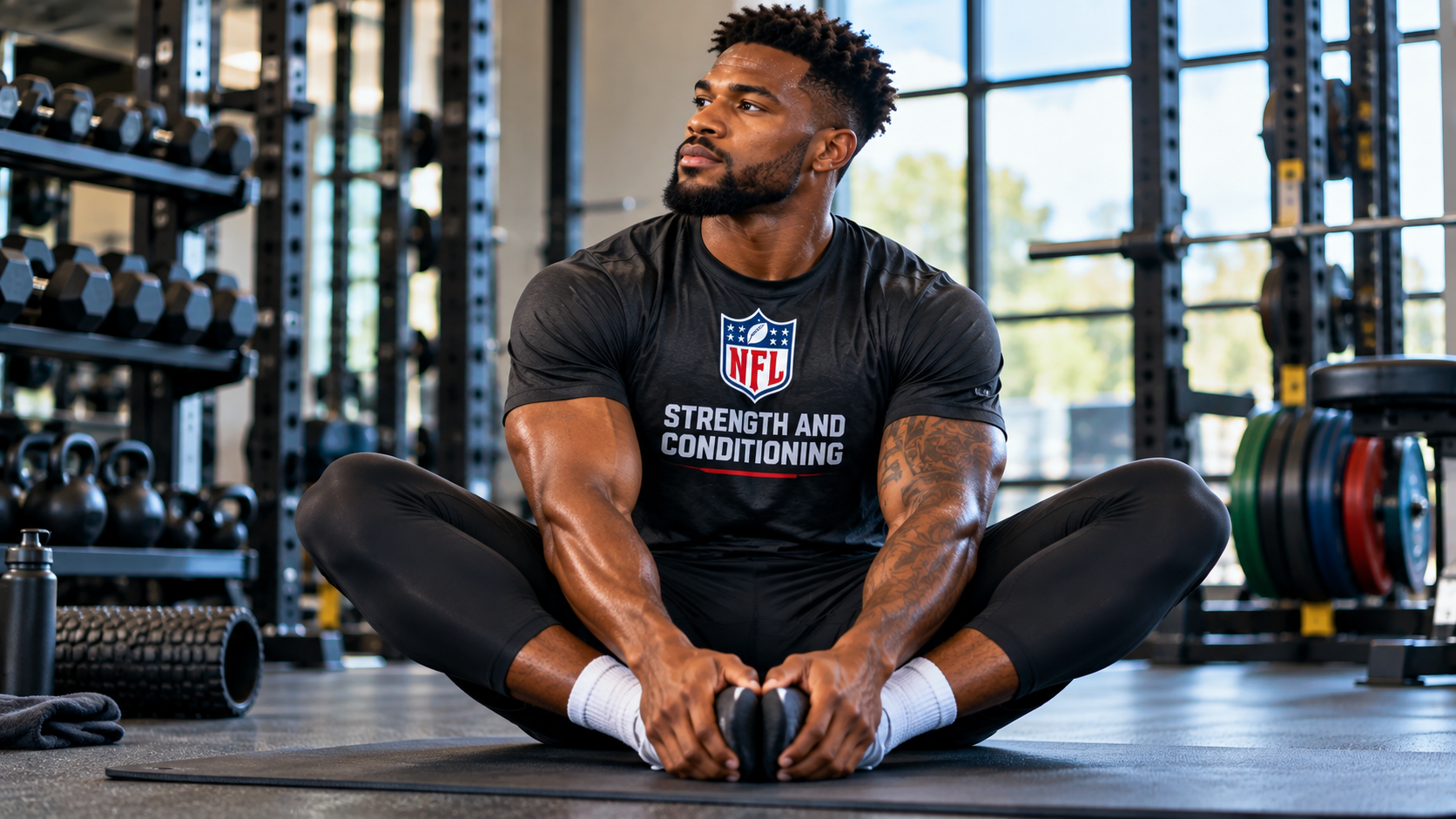
Professional football players prioritize movement quality to stay on the field and perform at their peak. You can adopt these same high-level principles at home to boost your own physical performance. True mobility is about more than just reaching your toes; it is about controlling your joints through a full range of motion.
Many people mistakenly believe that stretching is just sitting still. However, effective training combines strength with active movement. This is why professional programs integrate specific patterns that challenge your stability while you lengthen your muscles.
Whether you are exploring yoga for athletes to improve your speed or trying yoga for beginners to reduce daily aches, the goal remains the same. You want a body that moves well under pressure. Utilizing yoga for flexibility helps you build a durable frame that supports power, speed, and long-term health in your everyday life.
Key Takeaways
NFL-inspired mobility focuses on active range of motion rather than passive stretching.
Building strength within your stretches improves overall joint durability.
Consistent movement practice supports better speed and power for any sport.
Home-based routines can be simple, equipment-light, and highly effective.
Focusing on movement quality helps prevent injuries during daily activities.
Get your yoga routine started with a yoga mat from Gaiam, a #1 Best seller on Amazon Prime.
Affiliate Disclosure: This page contains affiliate links. If you purchase through one of these links, we may earn a commission at no additional cost to you. We only recommend products and services we believe may provide value to our readers.
What NFL Mobility Training Gets Right About Moving Better
If you want to move like a professional athlete, you need to understand the difference between being flexible and being mobile. While flexibility is simply the passive length of a muscle, mobility is the active control you have over your joints through a full range of motion. Many people focus on static stretching, but elite players know that true performance requires strength in every position.
Why football players train mobility instead of stretching passively
Passive stretching often relaxes the nervous system too much, which can temporarily reduce power output. Instead, NFL training emphasizes dynamic movement that keeps muscles engaged and ready for explosive action. By using yoga for athletes, players can maintain tension while lengthening, ensuring they stay strong even at their end range.
How usable range of motion supports speed, power, and durability
Restricted hips, ankles, and thoracic spines are common culprits behind poor performance and injury. When these areas are tight, the body creates compensations that hinder your ability to sprint, cut, or land safely. Usable range of motion allows you to access your full athletic potential without leaking energy through inefficient movement patterns.
When your joints move freely, you can generate more force during explosive movements like jumping or changing direction. This structural integrity is what keeps players on the field for entire seasons. By focusing on mobility, you build a foundation that supports both high-speed performance and long-term joint health.
Adapting professional athletic training to a home workout
You do not need a multi-million dollar training facility to replicate these professional methods. Incorporating yoga for athletes into your routine is a highly effective way to build stability and control at home. With just a simple mat, a sturdy chair, a wall, and a resistance band, you can mimic the specific positions that keep pros moving at their best.
These tools allow you to challenge your balance and strengthen your stabilizers in ways that traditional gym equipment cannot. By prioritizing active recovery and controlled movement, you can transform your home workout into a high-level training session. Consistency with these patterns will help you move with more confidence and less pain in your daily life.
Build an NFL-Style Mobility Session at Home
You can bring the intensity of an NFL training facility right into your living room. By applying professional athletic principles, you can create a routine that is perfect for yoga for beginners. This structured approach ensures that every minute you spend on the mat contributes to better movement and long-term physical health.
Choose a clear goal for each workout
Effective training starts with a specific focus. Instead of trying to improve everything at once, pick one area to prioritize during your session. You might choose to focus on ankle dorsiflexion, hip rotation, or upper-back mobility.
Selecting a single goal allows you to choose exercises that directly address your needs. This targeted strategy helps you track progress over time and keeps your sessions focused and efficient.
Prepare a safe training space with a mat, wall, chair, and resistance band
You do not need a fancy gym to see results. A small, clear area in your home is sufficient to perform these movements safely. Gather a few basic tools to support your practice:
A non-slip yoga mat for comfort and stability.
A sturdy wall for balance and leverage.
A stable chair for supported lunges and stretches.
A resistance band to add tension and muscle activation.
Use the athletic movement sequence: raise temperature, mobilize joints, activate muscles, and load range
Professional athletes follow a specific flow to prepare their bodies for high-impact performance. First, raise your body temperature with light movement to get blood flowing to your muscles. Next, mobilize your joints through their full range of motion to improve fluidity.
After mobilizing, move into muscle activation exercises to wake up dormant areas. Finally, load your range of motion by holding positions that challenge your strength and stability. This sequence ensures that each movement builds upon the last, creating a safe and effective path for your body.
Set a beginner-friendly intensity and breathing pace
When you are starting out, it is vital to keep the intensity moderate. Focus on maintaining proper alignment and balance rather than pushing for extreme depth. This approach makes the practice accessible for those exploring beginner yoga for the first time.
Keep your breathing steady and rhythmic throughout the entire session. Deep, controlled breaths help your nervous system stay calm, which allows your muscles to relax and release tension more effectively. Remember that consistency is far more important than intensity when you are building a new habit.
Warm Up the Ankles, Hips, and Spine Before Training
Preparing your body for high-intensity movement starts with a focused warm-up for your foundation. By dedicating time to your joints, you create a resilient base that supports explosive power and prevents unnecessary strain. This process ensures your body is ready to handle the demands of any athletic challenge.
Prime the ankles with controlled circles, knee-to-wall rocks, and calf raises
Your feet are the first point of contact with the ground, making ankle mobility exercises essential for stability. Start with slow ankle circles to lubricate the joint. Follow this with knee-to-wall rocks to improve dorsiflexion, which is vital for deep squats and landing mechanics. Finally, perform calf raises to wake up the lower leg muscles and prepare them for impact.
Open the hips with 90/90 transitions, hip airplanes, and supported lunges
The hips act as the engine for your movement, so incorporating hip mobility exercises is non-negotiable. Use 90/90 transitions to improve internal and external rotation capacity in a controlled manner. Hip airplanes challenge your balance while opening the hip capsule, and supported lunges help lengthen the hip flexors to improve your stride length.
Mobilize the thoracic spine with cat-cow and open-book rotations
Many athletes struggle with stiffness in the upper back, which often leads to compensation in the lower back. Improving thoracic spine mobility allows for better rotation and arm drive during sprints. Use cat-cow movements to articulate the spine, then move into open-book rotations to encourage healthy thoracic extension and rotation.
Connect the warm-up to football movements such as cutting, sprinting, and changing direction
Every movement in your warm-up should mirror the intensity of the game. When you perform these drills, visualize yourself cutting across the field or accelerating into a sprint. This mental connection ensures that your physical preparation translates directly into better performance on the field.
Joint Area
Primary Benefit
Key Movement
Ankles
Force Absorption
Knee-to-wall rocks
Hips
Rotational Power
90/90 transitions
Spine
Upper Body Control
Open-book rotations
Use Yoga for Athletes to Improve Strength Through a Full Range
Integrating yoga for strength training into your routine provides a unique way to challenge your muscles through full ranges of motion. Rather than viewing these movements as passive stretching, you should treat them as active, load-bearing exercises. This approach helps you build the stability required for high-impact sports.
Train single-leg control with Warrior III and supported balance work
Single-leg stability is vital for any athlete who needs to cut, sprint, or change direction quickly. Warrior III forces you to engage your glutes and core to maintain a level pelvis while balancing on one leg. Focus on keeping your standing knee slightly soft to ensure the muscles, rather than the joints, handle the load.
Build hip and hamstring strength with chair pose, crescent lunge, and bridge variations
These best yoga poses for athletes target the posterior chain and hip stabilizers effectively. Chair pose builds endurance in the quadriceps, while crescent lunge challenges your balance and hip flexor length simultaneously. Incorporating bridge variations allows you to isolate the glutes, which is essential for explosive power.
Develop shoulder and trunk control with plank, side plank, and downward-facing dog
A strong core acts as the anchor for all your movements on the field. Planks and side planks build isometric endurance in the trunk, protecting your spine during contact. Downward-facing dog serves as a functional way to develop shoulder stability and overhead control, which are critical for arm drive.
Pair slow yoga transitions with athletic intent
The secret to success lies in how you move between these shapes. By slowing down your transitions, you force your nervous system to maintain tension throughout the entire range of motion. This mindful control translates directly to better body awareness during intense competition.
Yoga Pose
Primary Benefit
Athletic Application
Warrior III
Single-leg stability
Cutting and pivoting
Crescent Lunge
Hip flexor strength
Sprinting mechanics
Side Plank
Oblique endurance
Rotational power
Bridge
Glute activation
Explosive jumping
Using yoga for athletes as a form of resistance training ensures your body remains resilient. When you combine these movements with consistent effort, you create a foundation that supports long-term durability and performance.
Follow a Beginner Yoga Sequence for Better Flexibility
Incorporating yoga for beginners into your weekly schedule is a smart way to improve your overall movement quality. You do not need to be a professional athlete to enjoy the benefits of a structured mobility routine. By focusing on steady, controlled movements, you can build a foundation that supports your body for years to come.
Start with child’s pose, tabletop, and gentle spinal motion
Begin your session by grounding yourself in child’s pose to calm the nervous system. Transition into a tabletop position to engage your core and prepare for movement. Gentle spinal waves, such as cat-cow, help wake up the vertebrae and improve your range of motion without unnecessary strain.
Progress through low lunge, half split, and lizard variations
Once your spine feels fluid, move into a low lunge to open the hip flexors. This is a staple of yoga for flexibility that helps counteract the tightness caused by sitting or intense training. Follow this with a half split to stretch the hamstrings, then transition into a lizard pose to deepen the hip opening.
Release the posterior chain with downward-facing dog and seated forward folds
Using beginner yoga shapes like downward-facing dog allows you to lengthen the entire back of the body. This pose is excellent for building shoulder stability while stretching the calves and hamstrings. Follow this with seated forward folds to encourage a deep, passive release in the lower back and legs.
Finish with supine twists and a relaxed breathing reset
The best yoga for improving flexibility always includes a period of cooling down. Lie on your back and perform gentle supine twists to release tension in the torso and hips. These beginner yoga sequences conclude with a few minutes of focused breathing, which helps your body transition into a state of recovery and calm.
Target the Mobility Areas NFL Athletes Depend On
Building a resilient body requires targeting the exact areas that NFL players prioritize for peak performance. When you focus on these specific zones, you create a foundation that supports both explosive power and long-term joint health.
Improve hip rotation for acceleration, deceleration, and lateral movement
Effective hip rotation mobility is the engine behind every sharp cut on the field. By increasing your internal and external rotation, you allow your hips to absorb force during deceleration and generate power during acceleration.
“True athletic movement is dictated by the ability of the hips to rotate freely under load.”
Restore ankle dorsiflexion for squatting, landing, and running mechanics
Many athletes overlook the importance of ankle dorsiflexion, yet it is vital for proper squat depth and safe landing mechanics. When your ankles move well, your knees and hips stay protected from unnecessary strain during high-impact activities.
Improves squat mechanics by allowing a more upright torso.
Reduces the risk of knee injuries during rapid changes in direction.
Enhances force production during the push-off phase of a sprint.
Increase hamstring and calf tolerance for sprinting and jumping
Building hamstring flexibility is not just about reaching for your toes; it is about creating tissue tolerance for high-speed movement. You must gradually expose these muscles to length under tension to prevent strains during explosive jumps or sprints.
Consistent, controlled loading helps your posterior chain adapt to the demands of the game. This approach ensures your muscles remain resilient rather than just loose.
Build thoracic and shoulder mobility for arm drive and upper-body control
Finally, your shoulder mobility and thoracic spine health dictate your upper-body efficiency. A mobile upper back allows for a powerful arm drive, which is essential for maintaining balance and speed while running.
By integrating these targeted movements, you ensure that your entire kinetic chain works in harmony. This holistic approach to hamstring flexibility and upper-body control is what separates casual gym-goers from high-performing athletes.
Apply the Workout to Running, Lifting, and Recovery Days
Whether you are lifting heavy or hitting the pavement, your mobility routine should adapt to the demands of the day. Instead of following a rigid, identical plan every time you train, you should align your movement work with your specific physical goals. A well-structured dynamic mobility routine acts as a bridge between your sedentary daily life and the high-intensity demands of your workout.
Use a dynamic mobility flow before strength training
When preparing for a heavy lifting session, your focus should be on priming the joints for load. Incorporating yoga for strength training helps to lubricate the hips and shoulders while activating the core muscles. This approach ensures that you can hit full depth in your squats and maintain a stable spine during overhead presses.
“Movement is the medicine for creating change in a person’s physical, emotional, and mental states.”
Choose yoga for runners to support stride mechanics and post-run recovery
Running places repetitive stress on the lower body, often leading to tight hamstrings and restricted hip extension. Utilizing yoga for runners allows you to target these specific areas, improving your stride length and overall efficiency. By focusing on deep lunges and gentle folds, you can effectively counteract the stiffness that often follows a long run.
Separate intense mobility work from high-speed sprint sessions
It is vital to keep your nervous system fresh when training for speed or explosive power. Avoid performing long, static holds or deep tissue work immediately before a sprint session, as this can temporarily reduce muscle stiffness needed for force production. Instead, save your most intense mobility sessions for later in the day or on non-sprinting days to ensure your performance remains at its peak.
Create a low-intensity recovery flow for rest days
Rest days are the perfect time to engage in recovery yoga to promote blood flow and reduce muscle soreness. Keep these sessions gentle, focusing on slow, rhythmic breathing and light stretches that do not push your body to its limit. This practice helps you stay consistent without adding unnecessary stress to your central nervous system.
Training Day
Mobility Focus
Intensity Level
Strength Training
Joint Priming
Moderate
Running
Hip & Ankle Opening
Low to Moderate
Sprint Work
Dynamic Activation
Low
Rest Day
Full Body Release
Very Low
Assemble a Practical 20-Minute Home Mobility Workout
Creating a consistent routine does not require hours in the gym or expensive equipment. By focusing on high-impact movements, you can build a 20-minute mobility workout that prepares your body for any athletic challenge. This efficient sequence mimics the preparation used by professionals to stay agile and injury-free.
Begin with three minutes of breathing and full-body movement
Start your session by calming the nervous system and increasing your core temperature. Spend the first minute focusing on deep, rhythmic breathing to center your focus. Follow this with two minutes of light, full-body movement like arm circles, torso twists, and gentle marching in place to wake up your muscles.
Spend five minutes on ankle, hip, and thoracic mobility
Targeting these three key areas is essential for athletic performance. Use these movements to improve your range of motion:
Ankle rocks: Perform knee-to-wall stretches to improve dorsiflexion.
90/90 hip transitions: Rotate your hips back and forth to unlock tight glutes.
Thoracic rotations: Use open-book stretches to improve spinal mobility.
Complete eight minutes of strength-focused yoga and athletic activation
Integrate the best yoga poses for athletes to build stability while you move. This phase emphasizes control and tension, which are vital for power production. Try these movements to maximize your results:
Warrior III: Hold for 60 seconds per side to challenge your balance and single-leg strength.
Crescent Lunge: Engage your core and glutes to stabilize the hips.
Plank to Downward-Facing Dog: Flow between these positions to build shoulder and trunk endurance.
Bridge Pose: Activate the posterior chain to support your lower back.
Use four minutes of flexibility work and controlled recovery
Finish your session by prioritizing yoga for improving flexibility through slow, intentional holds. Avoid forcing your body into extreme positions; instead, focus on deep breathing to encourage your muscles to release tension. Incorporating these beginner yoga sequences at the end of your workout helps lower your heart rate and signals to your body that it is time to recover.
By dedicating time to yoga for flexibility, you ensure that your muscles remain supple and responsive. Consistency is the secret to long-term success, so aim to complete this routine at least three times per week. Your body will thank you for the extra care and attention.
Conclusion
True physical longevity relies on the harmony between your range of motion and your active strength. You build a resilient body by focusing on your hips, ankles, hamstrings, calves, and thoracic spine. Integrating yoga for athletes into your weekly routine provides the stability needed for high-impact movement.
Aim to practice these movements three to four times every week. Short, consistent sessions yield better results than occasional, intense workouts that leave you feeling drained. Prioritize controlled transitions over forced stretches to protect your joints and improve your overall mechanics.
Your progress depends on patience and steady effort. By treating your mobility work with the same focus as your strength training, you create a foundation for lasting performance. Start your journey with yoga for athletes today to see how small, daily adjustments transform your ability to move with power and grace.
FAQ
Is yoga for athletes different from regular yoga?
Yes, while the poses are often the same, the intent differs. Yoga for athletes focuses on functional range of motion, joint stability, and active muscle engagement to support specific sport movements like sprinting or cutting, rather than just relaxation or spiritual practice.
I am very stiff; is yoga for beginners right for me?
Absolutely. In fact, if you are stiff, you have the most to gain. Beginner yoga programs are designed to use props like blocks or chairs to make positions accessible, ensuring you can improve your mobility without risking injury.
Can I use yoga for strength training instead of lifting weights?
While yoga is excellent for building “length-strength” and core stability, it usually complements weightlifting rather than replacing it. Poses like planks and balances are perfect examples of how yoga for strength training builds the “inner armor” that supports heavy lifting.
What are the best yoga poses for athletes to do every day?
Downward-facing dog, Crescent Lunge, and Warrior III are among the best yoga poses for athletes. They target the hamstrings, hip flexors, and balance, which are critical for almost every sport, including football and running.
How does yoga for runners help with performance?
Yoga for runners focuses on opening the hip flexors, strengthening the glutes, and improving ankle mobility. This helps maintain a proper stride length and prevents common overuse injuries like shin splints or IT band syndrome.
Can beginner yoga sequences actually improve my flexibility quickly?
Consistency is key. By following beginner yoga sequences three times a week, you’ll likely notice an improvement in your “usable” range within 14 to 21 days as your nervous system begins to trust the new positions.
Is yoga for flexibility safe to do after a heavy leg day?
Yes, but keep it gentle. Using yoga for improving flexibility after a workout helps circulate blood to the muscles and can reduce soreness. Avoid pushing into “pain” and focus on light, rhythmic movement.
Do I need special equipment for yoga for athletes at home?
Not necessarily. While a mat is helpful for grip, you can perform most beginner yoga movements on a carpeted floor. A standard household chair and a wall are the only “props” usually needed to modify poses for better stability.
Heads up: this post contains affiliate links. If you click through and make a purchase, we may earn a small commission at no extra cost to you — it’s how we keep the lights on and keep publishing free content. We only link to products we’d actually recommend to a friend.
Choosing the right equipment for your fitness journey often feels like a battle between tradition and personal comfort. While heavy bars have long dominated gym floors, many people find that a dumbbell workout offers a more natural path to physical success. These versatile tools allow your limbs to move independently, which helps you maintain better alignment during every repetition.
By using individual weights, you gain greater freedom to adjust your path of motion. This flexibility is essential for those who want to build strength while respecting their unique anatomy. You do not need a massive home gym to see real progress, as these compact items fit perfectly into any living space.
Focusing on functional movement ensures that your training remains consistent and effective over time. Whether you are a beginner or a seasoned athlete, embracing this approach can lead to better results and a more sustainable routine. Let us explore how this method transforms your daily activity into a smarter way to train.
Key Takeaways
Individual weights allow for a more natural range of motion compared to fixed bars.
Training with independent loads helps correct muscle imbalances between your left and right sides.
A compact setup makes it easy to maintain a consistent routine in small home spaces.
Greater freedom of movement supports better alignment and reduces unnecessary strain.
Focusing on functional patterns improves your overall strength and daily physical performance.
Want to get a pump in at home? Get your own set of Amazon Basics Hex dumbbells here.
Affiliate Disclosure: This page contains affiliate links. If you purchase through one of these links, we may earn a commission at no additional cost to you. We only recommend products and services we believe may provide value to our readers.
Why a Dumbbell Workout Supports Joint Health and Range of Motion
Your joints deserve a training approach that respects their natural alignment and movement patterns. When you choose dumbbell exercises, you move away from the rigid constraints of fixed equipment. This shift allows your body to find its own path, which is essential for maintaining long-term joint health.
How Independent Weights Let Each Arm and Shoulder Move Naturally
Traditional barbells force your hands into a fixed position, which often creates tension in the wrists and shoulders. Because dumbbells are independent, each arm can move through a path that feels natural for your specific anatomy. This freedom allows your joints to rotate and adjust throughout the entire movement.
By letting your shoulders track in their own arc, you reduce the risk of impingement. You can find the exact angle that feels stable and strong for your unique frame. This level of customization is a major benefit for anyone looking to train without unnecessary discomfort.
Why a Freer Path Can Reduce Unnecessary Joint Stress
A fixed bar path often forces your joints to compensate for an unnatural movement pattern. When you use dumbbells, you eliminate this forced alignment, which significantly lowers the stress placed on your connective tissues. This joint-friendly approach helps you avoid the repetitive strain that often leads to nagging aches.
You gain the ability to adjust your grip and elbow position on the fly. If a certain angle feels tight, you can simply rotate your wrists or shift your elbows to find a more comfortable groove. This flexibility is a cornerstone of sustainable strength training.
Range of Motion as a Tool for Stronger, More Comfortable Training
Many people mistakenly believe that a larger range of motion is always better, but the goal should be controlled movement. You should only move through a range that feels safe and productive for your body. Using dumbbells allows you to stop at the point where your muscles are fully engaged without pushing into painful territory.
By focusing on quality over quantity, you build strength while protecting your joints. This mindful approach ensures that every repetition contributes to your fitness goals rather than causing wear and tear. Ultimately, listening to your body is the most effective way to ensure your training remains both strong and comfortable for years to come.
How Dumbbells Compare With Barbells for Strength Training
When you step into the weight room, you face a choice between the rigid path of a barbell and the freedom of dumbbells. While both tools build muscle, they interact with your body in fundamentally different ways. Engaging in strength training with dumbbells allows for a more personalized movement experience that adapts to your unique anatomy.
Fixed Bar Paths Versus Self-Selected Movement Paths
A barbell forces your limbs into a single, fixed trajectory. This is excellent for moving heavy loads, but it does not account for the natural rotation of your wrists or the specific width of your shoulders. Your joints are often forced to conform to the bar rather than the other way around.
In contrast, dumbbells allow you to choose your own path. You can rotate your wrists or adjust your elbow angle mid-rep to find the most comfortable position. This freedom of movement is a primary benefit of incorporating dumbbells into your routine.
When Barbell Stability Becomes a Limitation
Barbells provide high levels of stability because the weight is connected across a single beam. This stability is helpful for beginners learning basic patterns, but it can become a drawback for those with joint discomfort. If your shoulders or wrists do not align perfectly with the bar, you may experience unnecessary strain.
Over time, forcing your body into these rigid positions can lead to overuse injuries. By prioritizing strength training with dumbbells, you reduce the risk of locking your joints into painful, repetitive patterns. This flexibility allows you to train harder while keeping your joints happy.
How Dumbbells Expose and Correct Left-to-Right Strength Differences
One of the most significant advantages of dumbbells is their ability to highlight imbalances. When you use a barbell, your stronger side often compensates for your weaker side without you noticing. This can lead to long-term muscle asymmetries.
Dumbbells force each arm to work independently. If your right side is stronger than your left, you will immediately feel the difference during your sets. This feedback loop is essential for building a balanced, symmetrical physique.
Why Barbells Still Have a Place in a Balanced Program
Despite the benefits of dumbbells, barbells remain a staple for a reason. They are unmatched when it comes to moving maximal loads safely and efficiently. For compound movements like the deadlift or back squat, the stability of a barbell allows you to focus on raw power output.
A well-rounded program often includes both tools. You might use barbells to build foundational strength and dumbbells to refine your movement quality and address specific weaknesses. By combining these methods, you get the best of both worlds for your strength training with dumbbells and overall fitness journey.
The Joint-Friendly Advantages of Dumbbell Exercises
Your choice of equipment significantly impacts how your body handles the stress of a workout. While barbells lock you into a rigid path, dumbbells allow for a more natural flow that respects your unique anatomy. This flexibility is a game-changer for anyone looking to train hard without sacrificing long-term joint health.
Neutral-Grip Options for More Comfortable Pressing and Pulling
A neutral grip, where your palms face each other, is often much kinder to the shoulders than a traditional pronated grip. By rotating your wrists, you can reduce the internal rotation that frequently causes impingement. Incorporating shoulder dumbbell exercises with a neutral grip allows you to maintain a stable scapular position throughout the movement.
Adjusting Wrist, Elbow, and Shoulder Positions During Each Rep
One of the greatest benefits of dumbbells is the ability to adjust your arm path mid-rep. If a specific angle feels tight or uncomfortable, you can slightly shift your elbow or wrist to find a smoother groove. This dynamic adjustment ensures that you are not forcing your joints into positions that cause unnecessary friction or strain.
Using a Controlled Range of Motion Without Forcing Painful Positions
It is a common misconception that you must always move through the absolute maximum range of motion to see results. True progress comes from working within a range that you can control with perfect form. If you feel sharp pain at the bottom of a press, simply stop an inch or two higher to keep the tension on your muscles rather than your connective tissues.
“The goal of training is to build strength, not to break your body down. Listen to your joints, as they are the best indicators of whether your movement pattern is truly serving your goals.”
Distinguishing Productive Effort From Joint Discomfort
Learning to tell the difference between muscle fatigue and joint pain is a vital skill for every lifter. Muscle fatigue feels like a burning sensation or a temporary loss of power, which is exactly what you want during shoulder dumbbell exercises. In contrast, joint discomfort often presents as sharp, stabbing, or lingering pain that persists after the set is finished.
If you experience that sharp, localized pain, it is time to adjust your load or your range of motion immediately. Prioritizing comfort does not mean you are taking the easy way out; it means you are training smart. By staying within a pain-free zone, you ensure that you can keep showing up to the gym consistently for years to come.
Building an Upper Body Dumbbell Workout Around Natural Movement
Designing an effective upper body dumbbell workout requires a focus on how your joints naturally move through space. By choosing movements that allow for individual adjustments, you can maintain high intensity while protecting your long-term joint health. The goal is to prioritize smooth, controlled repetitions rather than chasing the heaviest weight on the rack.
Chest Press Variations That Allow Individual Shoulder Paths
When you perform a chest press with dumbbells, you are not locked into a fixed bar path. This freedom allows your shoulders to rotate slightly, which is often much more comfortable than a rigid barbell movement. You can adjust your grip to a neutral position, palms facing each other, to reduce stress on the front of the shoulder.
Focus on keeping your shoulder blades retracted against the bench throughout the movement. This stability ensures that the chest muscles do the work while your joints remain in a safe, supported position.
One-Arm Rows for Back Strength and Scapular Control
One-arm rows are excellent for building back strength while allowing your torso to remain stable. By supporting yourself on a bench, you can focus entirely on the pulling motion without straining your lower back. This exercise encourages better scapular control, as you can feel each side working independently.
Try to pull the dumbbell toward your hip rather than straight up to your chest. This subtle change in angle often feels more natural and helps engage the latissimus dorsi more effectively.
Shoulder Dumbbell Exercises for Pressing, Raising, and Stabilizing
Shoulder training should emphasize controlled movement patterns that avoid painful overhead positions. You can start with seated presses to provide extra stability for your spine. If overhead pressing causes discomfort, consider performing lateral raises or front raises with a lighter load to build strength safely.
Always maintain a slight bend in your elbows during these movements. This simple adjustment prevents locking out the joint and keeps the tension focused on the deltoid muscles.
Dumbbell Exercises for Arms With Comfortable Elbow Positions
Finding the right dumbbell exercises for arms is all about respecting your natural elbow alignment. For bicep curls, you can rotate your wrists during the movement to find the path that feels best for your forearms. Hammer curls are a fantastic alternative if standard curls cause wrist or elbow irritation.
For triceps, overhead extensions or kickbacks allow you to isolate the muscle without needing heavy weight. Consistency and form are far more important than the size of the dumbbell when you are training for longevity. By keeping your movements smooth and deliberate, you will see better results without the risk of overuse injuries.
Effective Dumbbell Exercises for Full-Body Strength
Effective dumbbell workouts provide the perfect foundation for developing total-body power and stability. By focusing on movement patterns that mirror your daily activities, you can improve how you lift groceries, climb stairs, or stand up from a chair. These exercises build functional strength that translates directly into a more capable and resilient body.
Goblet Squats for an Accessible Squatting Pattern
The goblet squat is a fantastic way to learn proper squat mechanics while keeping your spine upright. By holding a single dumbbell against your chest, you create a natural counterbalance that helps you sit back into your hips. This movement is essential for maintaining the ability to squat comfortably as you age.
Dumbbell Romanian Deadlifts for Hip Strength and Hamstring Control
To build a strong posterior chain, the Romanian deadlift is unmatched. This exercise teaches you to hinge at the hips rather than rounding your back, which is vital for picking up heavy objects safely. Consistent practice with this movement strengthens your hamstrings and glutes, providing better support for your lower back.
Split Squats and Lunges for Balance and Unilateral Strength
Training one leg at a time helps you identify and correct strength imbalances that often go unnoticed. Split squats and lunges force your core to stabilize your body, improving your balance for activities like walking on uneven ground. These movements are highly effective dumbbell workouts for anyone looking to improve their athletic performance or daily mobility.
Keep your torso tall during lunges to engage your core.
Focus on a controlled descent to maximize muscle recruitment.
Use a weight that allows you to maintain perfect form throughout the set.
Farmer Carries for Grip, Posture, and Whole-Body Stability
The farmer carry is perhaps the most practical exercise you can perform. By simply walking while holding heavy dumbbells at your sides, you challenge your grip strength, shoulder stability, and core endurance. This movement mimics the physical demand of carrying luggage or heavy bags, making it a staple in any well-rounded fitness program.
How Unilateral Dumbbell Training Improves Balance and Control
Unilateral work provides a unique window into how your body truly functions under load. By isolating each limb, you can identify subtle movement flaws that often go unnoticed during standard two-handed lifts. This approach is essential for building a balanced and resilient physique.
Why Training One Side at a Time Reveals Compensation Patterns
When you use both hands or legs simultaneously, your stronger side often masks the weaknesses of the other. Unilateral dumbbell training forces each side to work independently, making it impossible for one limb to “carry” the other. You will quickly notice if one shoulder tracks differently or if one hip drops during a movement.
Identifying these patterns early allows you to address them before they lead to injury. Consistency in these movements helps you build a more symmetrical foundation for all your future training.
Using Single-Arm and Single-Leg Movements to Build Stability
Incorporating single-arm dumbbell exercises into your routine is a highly effective way to improve joint stability. Movements like the single-arm row or the split squat require your body to fight against rotation. This constant need for stabilization engages smaller, supporting muscles that are often neglected.
These exercises teach your brain to coordinate movement more efficiently. As you master these patterns, you will find that your overall balance improves significantly during daily activities.
How Offset Loading Challenges the Core Without Excessive Weight
You do not need heavy plates to challenge your core effectively. By holding a weight on only one side of your body, you create an “offset” load that forces your core to work overtime to keep you upright. This technique is excellent for building functional strength without putting unnecessary stress on your spine.
Movement Type
Primary Benefit
Core Engagement
Bilateral Press
Maximum Load
Low
Single-Arm Press
Stability
High
Offset Carry
Posture
Very High
Progressing From Supported Positions to Freestanding Exercises
Start your journey with supported movements to ensure safety and proper form. For example, perform rows while leaning on a bench to stabilize your torso. Once you feel confident and stable, you can transition to freestanding versions of these exercises.
Moving to a freestanding position increases the demand on your balance and coordination. This progression ensures that you continue to challenge your body while maintaining perfect technique throughout every repetition.
Choosing Dumbbell Loads, Repetitions, and Range of Motion
Precision in your training volume and load selection transforms how your body responds to exercise. By focusing on quality rather than just the number on the weight, you ensure that every movement serves your long-term health. Proper dumbbell load selection is the foundation of a sustainable fitness journey.
Selecting a Weight That Preserves Technique
The most effective weight is one that allows you to maintain perfect form from the first rep to the last. If your movement pattern breaks down, your joints often take the brunt of the stress. Always prioritize control over moving the heaviest possible iron.
If you find yourself swinging or using momentum to complete a set, the weight is likely too heavy. Dropping to a lighter pair of dumbbells allows you to engage the target muscles more effectively. This shift keeps your joints safe while still providing a significant stimulus for growth.
Using Repetition Ranges for Strength, Muscle Growth, and Joint-Friendly Volume
Different dumbbell repetition ranges serve unique purposes in your training program. Lower ranges, typically between five and eight reps, are excellent for building raw strength. These sets require heavier loads but demand strict focus on stability.
For muscle growth, moderate ranges of eight to twelve repetitions are often the sweet spot. If you are looking to improve endurance or manage joint sensitivity, higher ranges of fifteen to twenty reps work wonders. These higher volumes allow you to achieve a great pump without needing excessive weight that might irritate your connective tissues.
When to Increase Weight, Repetitions, or Movement Difficulty
Progressive overload is essential, but it does not always mean adding more weight. You can increase the total repetitions in a set or decrease your rest periods to keep challenging your body. When you can comfortably hit the top end of your target rep range with perfect form, it is time to progress.
You might choose to increase the weight by the smallest available increment. Alternatively, you can make the movement more difficult by slowing down your tempo. This smart approach ensures you continue to see results without risking injury.
How Tempo, Pauses, and Isometric Holds Add Challenge Without Heavier Loads
You do not always need a heavier dumbbell to make an exercise harder. By manipulating the tempo, you increase the time your muscles spend under tension. Try a three-second eccentric phase—the lowering part of the lift—to feel a deeper burn.
Adding a two-second pause at the most difficult part of the movement also builds incredible stability. Isometric holds, where you freeze the weight in place, force your muscles to work harder without the need for extra load. These techniques are perfect for joint-friendly training while still pushing your limits.
Dumbbell Workouts for Beginners and Lifters Managing Joint Limitations
If you are new to strength training, dumbbell workouts for beginners provide a safe and effective way to build muscle. Starting with the right approach helps you master movement patterns while keeping your joints happy and healthy.
Starting With Supported and Stable Dumbbell Exercises
When you first begin, stability is your best friend. Using supported positions, such as sitting on a bench or leaning against a wall, removes the need for complex balance. This allows you to focus entirely on the quality of each repetition.
Seated Overhead Press: Provides back support while you work your shoulders.
Chest-Supported Rows: Keeps your spine neutral and prevents lower back strain.
Glute Bridges: A stable way to activate your posterior chain without heavy loading.
Creating a Beginner-Friendly Full-Body Dumbbell Session
A simple, full-body routine is the most efficient way to see progress. You can perform these movements two to three times per week to build a strong foundation. Focus on controlled tempos rather than heavy weight.
Try this simple circuit to get started:
Goblet Squats: Hold one dumbbell at your chest to improve posture.
Dumbbell Romanian Deadlifts: Focus on a slow hinge to feel your hamstrings.
Floor Press: A safer alternative to the bench press for your shoulders.
Single-Arm Rows: Use a bench for support to keep your back flat.
Farmer Carries: Walk slowly while holding weights to build total-body stability.
Modifying Exercises for Sensitive Shoulders, Wrists, Knees, or Hips
It is perfectly normal to adjust movements to fit your body. If a specific angle causes discomfort, you should always look for a variation that feels neutral. For example, if your wrists hurt during pressing, try using a neutral grip with your palms facing each other.
For sensitive knees, shorten your range of motion in squats or use a box to limit depth. If your shoulders feel tight, keep your elbows tucked closer to your torso. Small tweaks often make a massive difference in how you feel during and after your session.
When to Stop Training and Seek Professional Guidance
Listening to your body is a vital skill for any lifter. While muscle soreness is common, sharp or shooting pain is a clear signal to stop immediately. If you experience persistent joint pain that does not go away with rest, it is time to consult a physical therapist or a qualified trainer.
“True strength is built through consistency and the ability to recognize when your body needs a change in approach.”
Never push through pain in hopes of seeing faster results. Prioritizing your long-term health ensures that you can continue your dumbbell workouts for beginners for years to come.
How to Program Dumbbell Workouts for Long-Term Joint Freedom
Building a body that lasts involves a thoughtful approach to movement patterns and recovery. When you focus on long-term dumbbell programming, you move away from short-term gains and toward a sustainable lifestyle. This strategy ensures your joints remain healthy while you continue to build functional strength.
A truly joint-friendly strength program relies on variety and balance. By rotating through different movement categories, you prevent overuse injuries and keep your muscles engaged in new ways.
Balancing Pressing, Pulling, Squatting, Hinging, and Carrying
To create a balanced routine, ensure every week includes at least one exercise from each fundamental category. Pressing and pulling movements build your upper body, while squats and hinges target your legs and lower back. Adding carries provides a unique challenge for your core and grip strength.
This holistic approach prevents muscle imbalances that often lead to discomfort. By spreading these patterns across your weekly schedule, you allow specific muscle groups to rest while others work.
Combining Heavy Strength Sets With Controlled Mobility Work
You do not need to lift heavy weights during every single session to see progress. Instead, alternate your heavy strength days with sessions focused on controlled mobility and technique. This method keeps your joints fluid and reduces the risk of inflammation.
Using lighter weights for mobility work allows you to explore your full range of motion safely. This practice is a cornerstone of any effective joint-friendly strength program.
Scheduling Recovery Between Upper Body and Full-Body Sessions
Recovery is just as important as the time you spend lifting. Aim to schedule at least one rest day between intense full-body workouts to let your central nervous system recover. If you prefer an upper-body split, ensure you alternate those days with lower-body or active recovery sessions.
Tracking Pain, Performance, Range of Motion, and Exercise Quality
Stop relying solely on the weight on the dumbbell to measure your success. Instead, track your long-term dumbbell programming by noting how your joints feel after each session. If you notice persistent pain, adjust your range of motion or reduce the load immediately.
Movement Category
Primary Benefit
Example Exercise
Pressing
Upper Body Strength
Dumbbell Bench Press
Pulling
Posture and Back Health
Single-Arm Row
Squatting
Leg and Core Stability
Goblet Squat
Hinging
Posterior Chain Power
Romanian Deadlift
Carrying
Whole-Body Endurance
Farmer Carry
Conclusion
Choosing the right tools for your fitness journey shapes how your body feels today and years from now. Dumbbells offer a unique way to honor your anatomy while building muscle and bone density. Embracing these tools allows you to move in ways that feel natural and sustainable.
You do not need to abandon barbells to see progress. Instead, you can integrate a joint-friendly dumbbell workout to address imbalances and improve your movement quality. This approach helps you maintain physical independence as you age by focusing on control rather than just raw weight.
The primary dumbbell training benefits include better unilateral stability and a personalized range of motion. By selecting weights that allow for perfect form, you protect your joints while challenging your muscles. Consistency remains the most important factor in your long-term success.
Start small by tracking your performance and listening to your body. Adjust your intensity based on how your joints respond to each session. You now have the framework to build a routine that supports your health for a lifetime.
FAQ
Why should I choose a dumbbell workout over using a traditional barbell?
While barbells are excellent for lifting maximal loads, a dumbbell workout offers superior joint health by allowing each limb to move independently. This freedom of movement accommodates your unique body mechanics, making it much easier to find comfortable, natural paths for your wrists, elbows, and shoulders compared to the fixed position of a bar.
How do dumbbell exercises specifically support joint longevity?
Unlike rigid machines or barbells, dumbbell exercises allow for “self-selected” movement paths. For example, if you have a history of shoulder discomfort, you can rotate your palms to a neutral grip (facing each other) during a press. This flexibility reduces unnecessary stress on the connective tissues while still allowing for a challenging and productive session.
Can I build significant muscle and strength training with dumbbells alone?
Absolutely. Strength training with dumbbells is highly effective because it requires more stabilization from smaller supporting muscles. Furthermore, because dumbbells force each side of the body to carry its own weight, they are the gold standard for identifying and correcting left-to-right strength imbalances that are often hidden by barbell training.
What are the best shoulder dumbbell exercises for someone with limited mobility?
For those with mobility restrictions, exercises like the neutral-grip overhead press or the scaption (a lateral raise performed in the “scapular plane”) are excellent. These shoulder dumbbell exercises allow the shoulder blade to move naturally without “pinching” the joint, helping you build stability and strength without forcing a painful range of motion.
How should I structure a comprehensive upper body dumbbell workout?
A well-rounded upper body dumbbell workout should balance “pushing” movements, like chest presses, with “pulling” movements, like one-arm rows. To round out the session, include specific dumbbell exercises for arms, such as hammer curls and tricep extensions, which allow you to adjust your wrist position to avoid elbow strain.
Are there effective dumbbell workouts that target the entire body?
Yes, you can achieve a high level of fitness with effective dumbbell workouts that focus on foundational patterns. Combining goblet squats, Romanian deadlifts, and farmer carries will challenge your legs, core, and grip simultaneously. These movements translate directly to real-world tasks, such as carrying heavy luggage or lifting objects from the floor safely.
What are the best dumbbell workouts for beginners who are just starting out?
The most successful dumbbell workouts for beginners prioritize stability and movement quality. Starting with supported exercises—such as a chest-supported row or a seated overhead press—allows the lifter to focus on the “feel” of the muscle working. As balance and confidence improve, you can transition to freestanding exercises like lunges or standing presses.
How do I know when to increase the weight or difficulty of my exercises?
Progression should never come at the expense of technique. Once you can complete all your repetitions with a smooth tempo and a full, pain-free range of motion, you can consider a heavier load. Renowned coaches like Dan John often suggest that if you can’t control the weight on the way down, it is likely too heavy for your current level of stability.
How often should I train to see results without overtaxing my joints?
Most trainees find success by scheduling three to four sessions per week, alternating between upper-body and full-body routines. This allows for adequate recovery. By tracking your performance and joint comfort rather than just the numbers on the weight stack, you can ensure long-term progress. If you ever experience sharp or escalating pain, it is essential to stop and consult a professional, such as a physical therapist from Select Physical Therapy, to address the underlying issue.
Heads up: this post contains affiliate links. If you click through and make a purchase, we may earn a small commission at no extra cost to you — it’s how we keep the lights on and keep publishing free content. We only link to products we’d actually recommend to a friend.
Have you ever wondered if your favorite playlist truly changes your gym results? Many people rely on rhythmic beats to find workout motivation during tough sessions. It often feels like the right song helps you push harder, but is there real science behind this feeling?
A 2020 meta-analysis of over 139 studies suggests that audio tracks do more than just entertain. Research links these sounds to enhanced physical output and lower perceived exertion. This means you might feel less tired while hitting your goals.
Finding consistent fitness motivation is a common hurdle for many athletes. Whether you seek exercise inspiration or better physiological efficiency, your personal preferences play a major role. We will explore how intensity and safety impact these results to help you train smarter.
Key Takeaways
Audio tracks can significantly lower your perceived level of effort during training.
Large-scale studies confirm that rhythmic sounds improve overall physical efficiency.
Personal taste remains the most important factor in choosing your training audio.
High-intensity sessions may benefit more from specific tempo-based playlists.
Always prioritize safety by staying aware of your surroundings in public spaces.
Over the ear Headphones Editor’s Pick: Soundcore by Anker Q20i Hybrid, get yours with our link.
Affiliate Disclosure: This page contains affiliate links. If you purchase through one of these links, we may earn a commission at no additional cost to you. We only recommend products and services we believe may provide value to our readers.
Why Music Is More Than Background Noise During Exercise
Scientific interest in how audio influences physical activity dates back over a century. In 1911, researcher Leonard Ayres observed that cyclists pedaled faster when a band played music compared to when they rode in silence. This early exercise music research laid the groundwork for understanding how sound waves interact with human movement.
The difference between feeling motivated and performing better
It is important to distinguish between the emotional boost of a catchy beat and actual physical output. Feeling motivated often translates to a better mood, but it does not always guarantee a faster pace or more strength. While you might feel like you are working harder, your body may be moving at the same speed as it would without music.
“Music is a powerful tool, but it is not a magic pill for physical capacity; it is a bridge between your mental state and your physical output.”
What researchers mean by exercise performance
When experts study music and exercise performance, they look for objective data points. They measure specific metrics such as power output, running pace, time-trial results, and overall endurance. These studies aim to see if a playlist can actually push an athlete to exceed their previous physical limits.
Researchers also track perceived exertion, which is how difficult an exercise feels to the individual. By lowering this perception, music allows people to train longer or harder before they feel the need to stop. This psychological shift is a key component of why many athletes incorporate audio into their training.
Why music effects vary between workouts and individuals
The impact of music is rarely the same for every person. Several factors influence how you respond to a playlist during a session:
Training level: Elite athletes may rely less on external stimuli than beginners.
Workout type: High-intensity intervals often benefit more from music than technical skill work.
Personal preference: A song that inspires one person might be a distraction for another.
Ultimately, the effectiveness of music and exercise performance depends on how well the audio aligns with your specific goals. Understanding your own response to rhythm can help you use sound as a strategic tool rather than just background noise.
Workout Motivation, Running with Music, Headphones for working out
Many athletes find that their internal drive shifts the moment they press play on their favorite tracks. This psychological boost often acts as a catalyst for better movement and sustained energy during tough sessions. By selecting the right audio, you can effectively manage your cardio motivation and push through plateaus that might otherwise stop you in your tracks.
How music can influence effort, mood, and focus
Music functions as a powerful distraction from the physical sensations of fatigue. When you listen to high-tempo songs, your brain often prioritizes the rhythm over the signals of discomfort coming from your muscles. This shift in focus allows you to maintain a higher level of intensity for a longer duration.
Beyond simple distraction, music can significantly elevate your mood. Positive emotional responses to familiar songs trigger the release of dopamine, which makes the act of exercising feel more rewarding. This mental state is essential for maintaining a sharp focus on your form and breathing throughout the session.
Why running with music feels easier for many people
For many, running with music provides a steady cadence that helps regulate pace. When your footsteps align with the beat, the movement feels more fluid and less taxing on the body. This synchronization reduces the mental load required to maintain a consistent speed, making the entire experience feel more natural.
“Music is a legal performance-enhancing drug. It can lower your perceived exertion and help you push past your limits.”
How headphones for working out support consistency and concentration
Investing in quality headphones for working out is a game-changer for those struggling with routine. A reliable pair of earbuds creates a personal “zone” that blocks out gym noise or environmental distractions. This sense of privacy helps you stay committed to your training plan even on days when your energy is low.
The following table highlights how different audio setups impact your training environment:
Feature
Standard Earbuds
Sports Headphones
Open-Ear Models
Stability
Low
High
High
Sweat Resistance
Minimal
Excellent
Excellent
Safety Awareness
Low
Moderate
High
Focus Level
Moderate
High
High
By using the right gear, you can ensure that your cardio motivation remains high throughout the week. Whether you are running with music or lifting weights, the right headphones for working out provide the consistency needed to reach your long-term fitness goals.
What Exercise-Music Studies Actually Measure
When researchers study the link between music and fitness, they look at much more than just how much fun you are having. To understand the true impact of a playlist, scientists rely on specific exercise performance measures that track physical output and mental state. This helps distinguish between a workout that simply feels better and one that actually produces superior results.
Performance outcomes such as pace, power, time, and endurance
In the world of workout research, scientists prioritize objective data that can be measured with precision. They often track how long an athlete can sustain a specific intensity before reaching exhaustion. Key metrics include:
Pace and Speed: How quickly a runner covers a set distance.
Power Output: The force generated during resistance training or cycling.
Time to Exhaustion: The duration an individual can maintain a specific effort level.
Heart Rate Recovery: How quickly the body returns to a resting state after intense activity.
Psychological outcomes such as perceived exertion and enjoyment
Beyond physical stats, music study results often focus on how the brain processes the stress of exercise. Researchers use standardized scales to measure how hard a person feels they are working, known as the Rating of Perceived Exertion (RPE). When music is present, many participants report lower RPE, even when their actual physical output remains high.
This psychological shift is vital because it suggests that music acts as a buffer against fatigue. By increasing enjoyment, athletes are often willing to train longer or push harder than they would in silence.
How laboratory studies differ from real-world gym and running research
It is important to recognize that controlled laboratory settings differ significantly from your local gym. In a lab, variables like temperature, equipment, and even the specific song tempo are strictly regulated to ensure accuracy. In contrast, real-world environments are full of distractions and variables that are harder to control.
Feature
Laboratory Study
Real-World Setting
Environment
Highly Controlled
Variable/Dynamic
Distractions
Minimal
High
Equipment
Standardized
Personal Choice
While lab data provides the foundation for our understanding, real-world workout research confirms that personal preference plays a massive role. The best music study results often highlight that when you choose music you personally enjoy, the benefits to your focus and endurance are significantly amplified.
How Music Can Reduce Perceived Effort
Have you ever wondered why your favorite playlist makes a tough run feel like a breeze? Many people find that listening to cardio music acts as a mental bridge, helping them push through barriers that would otherwise feel overwhelming. While the physical demands of your workout remain the same, your brain processes the experience differently when you are engaged with sound.
Distraction from discomfort, fatigue, and repetitive movement
Exercise often involves repetitive motions that can lead to boredom or an acute awareness of physical strain. By providing a competing stimulus, music serves as an effective form of exercise distraction. It draws your focus away from minor aches, heavy breathing, and the monotony of a treadmill or stationary bike.
When your mind is occupied by a melody or a driving beat, you are less likely to dwell on the sensation of fatigue. This shift allows you to maintain your form and consistency for longer periods. You essentially create a mental buffer that protects your motivation during long sessions.
Rhythm, attention, and the perception of exercise intensity
The rhythmic nature of music plays a vital role in how we interpret physical work. A steady beat can help synchronize your movements, making the act of running or cycling feel more fluid and natural. This synchronization often leads to a lower perceived effort, as your body moves in harmony with the tempo.
By capturing your attention, music prevents you from constantly monitoring your heart rate or checking the clock. This psychological shift is essential for those who struggle to stay engaged during endurance training. When you stop over-analyzing your intensity, you often find that you can sustain a higher level of output without feeling as drained.
Why music tends to help more during moderate-intensity workouts
It is important to note that the benefits of music are most pronounced during moderate-intensity exercise. At this level, your brain has enough bandwidth to process the music while still managing the physical task at hand. This is where perceived effort is most easily influenced by external audio cues.
However, during extremely high-intensity efforts, your body’s physiological signals become too loud to ignore. In these moments, the brain prioritizes survival and performance feedback over entertainment. While music remains a great companion, it cannot fully mask the intense physical demand of a maximum-effort sprint or a heavy lift.
Can Music Improve Pace, Power, and Endurance?
Does the rhythm of your favorite track truly translate into better physical output during a tough training session? Many athletes believe that the right soundscape acts as a catalyst for pushing past previous limits. While the psychological boost is well-documented, the physiological impact on speed and strength remains a subject of intense study.
Evidence for faster running and improved time-trial performance
Research indicates that cardio music can have a measurable impact on endurance activities. In a notable 2003 study, researchers found that participants listening to faster-paced tracks increased their cycling work output by as much as 15%. This suggests that when the tempo matches the desired cadence, the body may naturally sustain a higher level of effort.
However, the benefits are not universal across all intensity levels. Studies show that music does not consistently change running pace or heart rate when an athlete is already pushing at 90% of their peak oxygen uptake. At such extreme levels, the body’s physiological demands often override the external influence of sound.
Music’s potential effect on repeated sprints and resistance training
When it comes to lifting weights or performing repeated sprints, the results are often more varied. While motivational workout music can help athletes maintain focus during long sets, its effect on maximal strength is less consistent. Some lifters report feeling stronger, yet the actual power output measured in laboratory settings does not always show a significant increase.
The primary value here lies in the ability to maintain consistency during repetitive movements. By reducing the focus on fatigue, sound can help athletes complete their planned repetitions with better form. This is particularly useful for those who struggle with the mental monotony of high-volume training.
Pre-workout music and short-term performance readiness
Using performance music before a session can serve as an effective tool for mental priming. Many athletes use high-energy tracks to reach a state of readiness, helping them transition from a sedentary state to an active one. This pre-workout ritual can sharpen focus and increase arousal levels before the first set begins.
Activity Type
Performance Impact
Primary Benefit
Endurance Cycling
High (up to 15% increase)
Improved work output
Resistance Training
Moderate/Variable
Enhanced focus and consistency
High-Intensity Sprints
Low/Neutral
Psychological readiness
Maximal Strength
Minimal
Mental arousal
Tempo, Lyrics, and the Science Behind the Best Running Songs
The secret to a great workout often hides within the beats per minute of your favorite tracks. While many people choose music based on genre, the music tempo for running plays a much larger role in how your body responds to physical stress. Finding the right rhythm can turn a difficult session into a manageable challenge.
How beats per minute can support pacing and movement efficiency
Research suggests that a tempo of approximately 120 beats per minute (BPM) often helps people stay engaged during moderate exercise. This steady rhythm acts as a metronome, helping you maintain a consistent cadence. When your steps align with the beat, you may notice improved movement efficiency and less wasted energy.
“Music is the shorthand of emotion, and when matched to movement, it becomes a powerful engine for physical performance.”
Choosing faster music for intervals and slower music for recovery
Your workout playlist should be as dynamic as your training plan. During high-intensity intervals, faster tracks can provide the extra push needed to maintain power. One study on cycling showed that a 10% increase in tempo led to better distance and higher enjoyment levels.
However, you must be careful not to let the beat force an unsustainable pace. Use slower, calming songs during your recovery phases to help your heart rate return to baseline. Balancing these speeds ensures you get the most out of every training block.
Lyrics, emotional meaning, and the role of personal preference
While tempo provides the structure, the emotional connection to a song is what truly drives motivation. The best running songs are often those that hold personal significance or trigger a positive memory. Lyrics can provide a mental distraction, helping you push through fatigue when the workout gets tough.
Ultimately, there is no universal formula that works for every athlete. You should prioritize tracks that make you feel confident and energized. Experimenting with different styles will help you build a collection that supports your unique fitness goals.
Running with Music: When It Helps and When It Gets in the Way
Deciding when to plug in and when to unplug can significantly change your training experience. While many athletes rely on audio to push through tough miles, understanding the trade-offs is essential for long-term success.
Benefits for long runs, steady-state cardio, and difficult intervals
For many, running with music serves as a vital source of long-run motivation. During steady-state cardio, a consistent beat helps maintain a steady cadence, making the time pass more quickly while reducing the perception of fatigue.
When tackling difficult intervals, high-tempo tracks can provide the necessary psychological boost to maintain intensity. This rhythmic support helps you stay locked into your effort, especially when your body starts to signal that it wants to slow down.
Situations where silence or ambient sound may improve awareness
Prioritizing running safety often means knowing when to turn the volume down or off entirely. If you are navigating busy city streets or complex trail terrain, you need to hear traffic, cyclists, or other potential hazards.
Silence is also a powerful tool for developing your internal clock. By listening to your own breathing and footfalls, you gain better feedback on your current exertion level and physical form.
Using music without losing control of pace or running form
It is important to remember that running with music should not distract you from your biomechanics. If you find yourself speeding up uncontrollably because of a fast song, you risk burnout or injury before your workout is complete.
Research suggests that when you shift your focus to maximal sprinting, the brain may struggle to synchronize movement with a beat. In these moments, focusing on your body rather than the playlist is often the better strategy for peak performance.
Ultimately, long-run motivation is best sustained when you use audio as a supplement rather than a crutch. Maintaining running safety and awareness ensures that you stay in control of your pace, regardless of what is playing in your ears.
Choosing Headphones for Working Out Without Sacrificing Safety
Selecting the perfect pair of headphones for working out requires balancing high-quality sound with the practical demands of your training environment. While music can drive your intensity, your gear must support your movement rather than hinder it.
Secure fit, sweat resistance, battery life, and comfort
A reliable pair of earbuds should stay in place during explosive movements or long-distance runs. Look for models with ergonomic ear hooks or multiple tip sizes to ensure a secure fit that won’t distract you mid-set.
Sweat resistance is another non-negotiable feature for any serious athlete. Ensure your device carries an IPX rating, which confirms it can withstand moisture and heavy perspiration. Additionally, prioritize long battery life so your music doesn’t cut out during your final, most challenging repetitions.
Our choice? The Soundcore by Anker Q20i Hybrid Active Noise Cancelling Headphones are a top choice on Amazon Prime. With a rating of 4.5 stars from over 75,000 reviewers, we’re in good company recommending this pair. Good sound quality, and better fit for active movements, all at an affordable price. I’ve used Anker products dating back years and have never had a bad experience. These will be perfect for your next workout.
Open-ear and transparency features for outdoor awareness
When you train outdoors, maintaining situational awareness is a critical component of workout headphone safety. Traditional noise-canceling earbuds can block out traffic, cyclists, and other environmental hazards.
Consider using open-ear designs or models with a dedicated transparency mode. These features allow ambient sound to pass through, keeping you connected to your surroundings while still enjoying your favorite high-energy tracks.
How gym headphones can support motivation without excessive volume
Using gym headphones effectively means finding a volume level that keeps you focused without damaging your hearing. You should be able to hear your own breathing and the rhythmic impact of your feet, which provides essential feedback on your form.
If you find yourself cranking the volume to drown out the gym’s background noise, you might be risking your long-term ear health. Instead, choose gear with a better seal or active noise cancellation that works at lower, safer volumes to maintain your workout headphone safety.
Feature
In-Ear Buds
Open-Ear/Bone Conduction
Over-Ear Gym Headphones
Best Use Case
High-Intensity Cardio
Outdoor Running/Cycling
Strength Training
Awareness
Low (unless transparent)
High
Moderate
Stability
High
Very High
Moderate
Comfort
Variable
High
High
Why Music Does Not Boost Performance for Everyone
While many athletes swear by their playlists, the reality is that music does not provide a universal performance boost for everyone. The impact of audio on your training is highly subjective and depends on a variety of personal factors. Understanding these nuances is key to maintaining your fitness motivation without relying on external crutches.
Training level, age, fitness goals, and music preferences
Your background and current goals significantly influence how you process sound during a workout. Elite athletes often require deep mental immersion, while beginners might use audio to mask the discomfort of a new routine. Personalized workout music is far more effective than generic top-40 hits because it aligns with your specific emotional triggers.
Age and Experience: Older adults may prefer lower-tempo tracks that support steady movement.
Goal Alignment: High-intensity goals often require aggressive beats, while recovery sessions benefit from calm, ambient sound.
Personal Taste: If you dislike the genre, your brain may perceive the sound as an annoying distraction rather than a motivator.
Why unfamiliar or distracting music can reduce concentration
When you listen to music that is too complex or unfamiliar, your brain works harder to process the auditory information. This extra cognitive load can pull your exercise focus away from your form and breathing. If the rhythm does not match your natural movement pattern, it can actually disrupt your flow.
Studies suggest that when music becomes a distraction, it can lead to a decrease in output. It is often better to choose tracks you know well so that your brain can process them in the background. This allows you to keep your exercise focus sharp while enjoying the benefits of a familiar rhythm.
Workout types where technique and feedback matter more than entertainment
Certain activities require a high level of concentration that music might hinder. Movements involving complex balance, coordination, or heavy lifting require you to listen to your body’s internal feedback. In these cases, silence or minimal audio is often the superior choice.
Consider these scenarios where you might want to skip the headphones:
Technical Lifting: Focusing on bar path and stability requires total mental presence.
Balance Training: Auditory input can sometimes interfere with your vestibular system.
Group Classes: You need to hear instructor cues to ensure safety and proper form.
Ultimately, personalized workout music should serve as a tool to enhance your experience, not a requirement for success. If you find that your playlist is interfering with your progress, do not be afraid to train in silence. True fitness motivation comes from within, and sometimes the best soundtrack is the sound of your own breath.
How to Build a Workout Playlist That Supports Real Progress
Building a high-performance workout playlist requires more than just picking your favorite songs. By organizing your audio to match the intensity of your session, you can turn music into a functional tool for success. A well-structured list helps you maintain focus while keeping your body ready for the demands of your training plan.
Match playlist energy to warm-up, training, and cooldown phases
Your audio should evolve alongside your physical state during a session. Start your warm-up with tracks that have a steady, moderate tempo to help you transition into a state of readiness. As you move into the main training block, shift to high-energy tracks that provide the necessary workout motivation to push through fatigue.
Finally, choose slower, calming songs for your cooldown. This helps your heart rate return to normal and signals to your brain that the hard work is complete. Using this phased approach ensures that your music supports your recovery as much as your effort.
Use song tempo to support pacing without forcing an unsustainable speed
Selecting the best running songs involves finding a balance between rhythm and your natural movement. While a fast beat can be exciting, it should not force you to run or lift at a pace that leads to burnout. Use music to maintain a consistent cadence rather than chasing an intensity level that you cannot sustain for the duration of your workout.
Think of your music as a metronome for your movement. When you find the right tempo, you can improve your efficiency and reduce the feeling of exertion. This allows you to stay in a flow state for longer periods during your training.
Combine motivational workout music with planned training targets
Integrating motivational workout music into your routine works best when it aligns with specific goals. If you have a difficult interval session, save your most powerful tracks for those high-intensity bursts. This strategy provides a psychological boost exactly when you need it most.
The following table outlines how to organize your audio for a balanced session:
Phase
Goal
Music Style
Tempo (BPM)
Warm-up
Activation
Steady, upbeat
100-120
Training
Performance
High-energy, driving
125-145
Intervals
Max Effort
Intense, rhythmic
145+
Cooldown
Recovery
Slow, ambient
80-100
By treating your workout playlist as a core component of your training, you gain a reliable way to manage your energy. Remember that the best running songs are those that keep you moving forward while respecting your physical limits. Stay consistent, keep your goals in sight, and let the music drive your workout motivation.
Conclusion
Music serves as a powerful tool to elevate your training sessions. It boosts your mood and lowers your perceived effort during tough intervals. You should view your audio choices as a personal performance enhancer rather than a universal solution for every athlete.
Finding the right exercise inspiration requires trial and error. You might discover that high-tempo tracks push you through a plateau, while others prefer silence to maintain focus on complex movements. Your unique fitness goals dictate which sounds work best for your specific routine.
Quality gym headphones play a vital role in this process. They provide the comfort and stability needed to keep your focus on the task at hand. Select gear that allows for environmental awareness to keep your outdoor runs safe and effective.
Build your playlists with intention to match your training phases. Balance your need for rhythm with your commitment to proper form and technique. Use these tools to support your long-term progress while staying mindful of your body and your surroundings.
FAQ
Does listening to music actually improve physical performance or is it just a distraction?
It is both! A major 2020 meta-analysis of 139 studies confirmed that music improves exercise performance by enhancing power output and endurance while simultaneously acting as a psychological distraction. By providing exercise inspiration, music lowers your perceived exertion, meaning you can work harder without feeling like you are putting in extra effort.
What are the best running songs to include in a workout playlist?
The best running songs typically feature a high tempo, usually between 120 and 140 beats per minute (BPM). Tracks like “Can’t Stop” by the Red Hot Chili Peppers or “Mr. Brightside” by The Killers are favorites because their rhythm helps runners maintain a consistent cadence. Ultimately, the most effective motivational workout music is subjective; a song you personally love will provide more fitness motivation than a generic high-tempo track you dislike.
How do headphones for working out affect my exercise consistency?
High-quality headphones for working out, such as the Beats Powerbeats Pro or Jabra Elite series, can help establish a “focus zone.” By blocking out gym distractions or creating an immersive environment, gym headphones help you stick to your workout playlist, making the routine more enjoyable and easier to maintain over the long term.
Is running with music safe for outdoor athletes?
A: Running with music is safe as long as you maintain situational awareness. Many runners now use open-ear headphones from brands like Shokz, which use bone conduction technology to keep the ear canal open. This allows you to enjoy your cardio music while still hearing traffic, cyclists, and other environmental cues.
Can music help with heavy lifting and resistance training?
While the benefits are most pronounced in rhythmic cardio, workout motivation from music also extends to the weight room. Listening to motivational workout music before a big lift can increase “pre-workout readiness” and emotional arousal, helping you find the fitness motivation needed for explosive movements or high-intensity sets.
Who was the first person to scientifically study music and exercise?
Research into this field dates back to 1911, when researcher Leonard Ayres observed that cyclists pedaled significantly faster when a band was playing compared to when they rode in silence. This pioneered the study of how cardio music impacts physiological efficiency and pace.
Why does some music make me feel tired instead of energized?
If a song’s tempo is too slow or the lyrics have negative emotional associations, it can actually decrease your workout motivation. Furthermore, if the music is unfamiliar or distracting during a technical activity—like a complex yoga flow or a maximum-speed sprint—it can interfere with your coordination and reduce exercise performance.
Does the volume of my workout playlist matter?
While loud music can increase exercise inspiration, it’s important not to exceed safe decibel levels. Using gym headphones with a good seal or active noise cancellation, like the Sony WH-1000XM5, allows you to hear the nuances of your music at lower, safer volumes without being drowned out by background noise.
Heads up: this post contains affiliate links. If you click through and make a purchase, we may earn a small commission at no extra cost to you — it’s how we keep the lights on and keep publishing free content. We only link to products we’d actually recommend to a friend.
As the air turns crisp, nothing beats the comfort of a warm, spiced treat. Our latest high protein dessert brings the best of the season straight to your kitchen. These muffins offer a perfect balance of cozy spices and wholesome ingredients that keep you satisfied throughout the day.
We combine nutrient-dense oats, creamy Greek yogurt, and fresh eggs to create a moist texture without the need for heavy fats. This blend makes them a standout among fall recipes, providing a boost of energy whenever you need it most. You will love how simple they are to prepare for your weekly meal prep.
Whether you enjoy them as a quick breakfast or a midday snack, these muffins support mindful habits and healthy eating. Each batch yields twelve delicious portions, making them ideal for sharing with family or stocking up for busy mornings. Discover how easy it is to enjoy a nutritious snack that feels like a true indulgence.
Key Takeaways
These muffins provide a balanced nutritional profile using Greek yogurt and oats.
The recipe yields twelve servings, perfect for convenient weekly meal prep.
They serve as a versatile option for breakfast, snacks, or entertaining guests.
Natural ingredients ensure you enjoy seasonal tastes without unnecessary additives.
Simple preparation steps make this an approachable choice for any home baker.
Affiliate Disclosure: This page contains affiliate links. If you purchase through one of these links, we may earn a commission at no additional cost to you. We only recommend products and services we believe may provide value to our readers.
High Protein Dessert: Why Pumpkin Muffins Belong in a Healthy Fall Recipe Collection
Fall is the perfect time to rethink your favorite seasonal treats by incorporating more nutrition into every bite. While many fall flavors recipes focus on heavy sugars and refined flours, you can easily shift your focus toward a high protein dessert that fuels your body. By making small, intentional swaps, you turn a simple snack into a powerhouse of energy.
How Pumpkin, Protein, and Fall Flavors Create a Satisfying Treat
The magic of this recipe lies in the combination of nutrient-dense ingredients. Pumpkin puree provides essential fiber and vitamins, while protein powder and Greek yogurt add the satiety needed to keep you full longer. This synergy ensures that your pumpkin dessert feels like a treat without the typical energy crash.
When you combine these elements, you create a texture that is both moist and satisfying. The natural sweetness of the pumpkin pairs perfectly with warm spices like cinnamon and nutmeg. This creates a cozy experience that fits perfectly into any healthy autumn routine.
What Makes These Muffins Lower in Sugar Than Traditional Pumpkin Desserts
Traditional baked goods often rely on excessive amounts of white sugar to achieve flavor. In contrast, this low sugar dessert utilizes the natural sweetness of pumpkin and high-quality protein powders. By reducing added sugars, you allow the authentic, earthy notes of the spices to shine through.
The following table highlights the key differences between a standard bakery muffin and this protein-rich alternative:
Feature
Traditional Muffin
High Protein Muffin
Primary Protein Source
Minimal (Eggs/Flour)
Greek Yogurt & Protein Powder
Sugar Content
High (Refined Sugar)
Low (Natural/Stevia)
Fiber Density
Low
High (Pumpkin/Oats)
Satiety Level
Short-term
Long-lasting
Who Will Enjoy These Protein-Packed Treats
These muffins are ideal for anyone looking to maintain their health goals without giving up seasonal favorites. Fitness enthusiasts will appreciate the added protein for muscle recovery after a workout. Meanwhile, busy parents can rely on them as a quick, nutritious breakfast option for the whole family.
If you are someone who craves a guilt-free indulgence during the holidays, this recipe is for you. It bridges the gap between wanting a delicious treat and needing to stay on track with your nutrition. Whether you are at the office or on the go, these muffins provide a convenient way to enjoy the season.
Ingredients for Soft, Moist High Protein Pumpkin Muffins
Creating the perfect pumpkin muffin starts with understanding how each ingredient works together to build a delicious result. When you select high-quality components, you ensure that your autumn recipes turn out perfectly every single time. These simple building blocks are the secret to achieving a bakery-style texture at home.
Pumpkin Muffin Ingredients and Their Roles
The foundation of these muffins relies on pure pumpkin puree, which provides essential moisture and a rich, earthy flavor. You will also need a reliable leavening agent like baking powder to ensure the muffins rise properly. Binding agents, such as eggs or flax eggs, hold the structure together while keeping the crumb tender.
Choosing Protein Powder for the Best Texture and Taste
Selecting the right protein powder is vital for creating successful protein-packed treats. We highly recommend using a high-quality vanilla whey or plant-based blend. Vanilla acts as a neutral base that complements the warm notes of cinnamon, nutmeg, and ginger found in pumpkin spice.
Be mindful that some powders absorb more liquid than others. If your batter looks too thick, simply add a splash of almond milk to reach the desired consistency. This small adjustment keeps your muffins from becoming dry or rubbery during the baking process.
Optional Add-Ins for Extra Fall Flavors
Customizing your muffins is the best way to make them your own. You can fold in dark chocolate chips for a decadent touch or add chopped walnuts for a satisfying crunch. Shredded coconut also works beautifully to add a subtle sweetness and extra moisture to the final product.
Ingredient
Primary Function
Best Practice
Pumpkin Puree
Moisture & Flavor
Use 100% pure pumpkin
Vanilla Protein
Structure & Sweetness
Whisk well to avoid clumps
Walnuts
Texture & Healthy Fats
Toast lightly before adding
Dark Chocolate
Flavor & Indulgence
Use mini chips for even spread
Smart Ingredient Swaps for Different Dietary and Nutrition Goals
Making a few smart ingredient swaps allows you to enjoy a low sugar dessert that aligns with your personal wellness goals. Whether you are focusing on healthy eating or managing specific food sensitivities, these adjustments ensure everyone can enjoy a seasonal treat.
Gluten-Free Flour Options for Pumpkin Muffins
If you need to avoid gluten, certified gluten-free oat flour is an excellent choice for a soft crumb. Always ensure your oats are labeled as certified gluten-free to prevent issues with cross-contact during processing.
You can also use a high-quality 1-to-1 gluten-free baking blend. These mixes often contain xanthan gum, which helps maintain the structure of the muffin when using protein powder.
Dairy-Free Alternatives to Greek Yogurt and Milk
Replacing Greek yogurt is simple if you prefer a dairy-free lifestyle. You can use a thick, unsweetened coconut or almond milk yogurt as a direct substitute.
For an extra protein boost, blended cottage cheese works beautifully as a creamy base. If you choose a plant-based milk, ensure it is unsweetened to keep your treat within your low sugar dessert targets.
Lower-Sugar Swaps for a More Balanced Dessert
To keep your muffins aligned with healthy eating habits, consider using natural sugar alternatives. Granulated monk fruit or stevia blends provide sweetness without the blood sugar spike associated with refined white sugar.
These sweeteners measure cup-for-cup, making them very easy to use in your favorite recipes. They help maintain the moisture of the muffin while keeping the overall carbohydrate count lower.
Egg-Free Substitutions and Their Effect on Texture
If you need to avoid eggs, a flax egg is a reliable binder. Simply mix one tablespoon of ground flaxseed meal with three tablespoons of water and let it sit until thickened.
Keep in mind that flax eggs may result in a slightly denser crumb compared to traditional eggs. Non-dairy yogurts can also act as a binder, though they might slightly increase the moisture content of the final product.
Ingredient
Standard Option
Substitution
Best For
Flour
All-Purpose
GF Oat Flour
Gluten-Free
Binder
Large Egg
Flax Egg
Vegan/Allergy
Sweetener
Cane Sugar
Monk Fruit
Low Sugar
Dairy
Greek Yogurt
Coconut Yogurt
Dairy-Free
How to Make Protein-Packed Pumpkin Muffins From Scratch
Let’s walk through the steps to create your new favorite snack. Mastering these fall recipes at home is easier than you might think, and the results are far superior to store-bought versions.
Prepare the Oven, Muffin Pan, and Baking Liners
Start by preheating your oven to 350 degrees Fahrenheit. Proper temperature control is essential for achieving the perfect rise.
Line your muffin tin with paper liners or lightly grease the cups with non-stick spray. This simple step ensures your protein-packed treats release easily without sticking to the pan.
Combine the Dry Ingredients Without Overmixing
In a large mixing bowl, whisk together your oat flour, protein powder, baking powder, and signature spices. If you are using rolled oats, simply pulse them in a blender until they reach a fine, flour-like consistency.
1.5 cups oat flour
1 scoop vanilla protein powder
1 teaspoon baking powder
2 teaspoons pumpkin pie spice
Whisk the Pumpkin-Based Wet Ingredients Until Smooth
In a separate bowl, combine your pumpkin puree, Greek yogurt, eggs, and a touch of sweetener. Whisk these ingredients vigorously until the mixture is completely smooth and uniform.
“The secret to a moist muffin lies in the balance of the wet ingredients; ensure your yogurt and eggs are at room temperature for the best emulsion.”
Fold the Batter Together for Tender Muffins
Gently pour the wet mixture into the dry ingredients. Use a spatula to fold the batter just until the flour streaks disappear, as overmixing can lead to a tough texture in these autumn recipes.
Divide the batter evenly among the twelve muffin cups. Bake for twenty-five to thirty minutes, or until a toothpick inserted into the center comes out clean.
These protein-packed treats are a staple among healthy fall recipes. Once you master this method, you can easily adapt these autumn recipes to suit your personal taste preferences.
How to Get the Best Pumpkin Spice Flavor and Muffin Texture
Creating professional-quality pumpkin spice desserts at home requires a few simple technical adjustments. When you master the balance of spices and the science of protein-based baking, you can easily elevate your fall flavors recipes to a new level of deliciousness.
Balancing Pumpkin Spice With Cinnamon, Nutmeg, and Ginger
The key to a warm, inviting flavor profile is avoiding an overwhelming spice blend. While pumpkin pie spice is convenient, adding individual notes of cinnamon, nutmeg, and ginger allows you to customize the intensity.
Start with a base of high-quality pumpkin pie spice.
Add a pinch of extra cinnamon for warmth.
Use a light touch with nutmeg and ginger to prevent a harsh, biting aftertaste.
Preventing a Rubbery Texture From Too Much Protein Powder
Protein powder acts differently than traditional flour, often absorbing moisture rapidly. If you use too much, your muffins may become dense or rubbery rather than light and fluffy.
To maintain a tender crumb, ensure that protein powder does not exceed one-third of your total dry ingredients. Balancing it with a lighter flour, such as oat or almond flour, helps preserve the delicate structure of your pumpkin spice desserts.
Using Room-Temperature Ingredients for Even Mixing
Temperature plays a vital role in how fats and proteins emulsify within your batter. Using room-temperature eggs and Greek yogurt ensures that the ingredients blend smoothly without requiring excessive mixing.
Overmixing is a common mistake that leads to tough muffins. When your ingredients are at the right temperature, they incorporate quickly, keeping your fall flavors recipes light and airy.
Adjusting Batter Consistency for Different Protein Powders
Not all protein powders are created equal, as whey, casein, and plant-based blends absorb liquid at different rates. You should always observe the thickness of your batter before filling the muffin tins.
If the batter appears too thick or dry, add a tablespoon of almond milk or water at a time. A smooth, pourable consistency is the best indicator that your muffins will bake evenly and retain a moist texture.
Nutrition, Portions, and Serving Ideas for Healthy Eating
Mastering the art of healthy eating involves balancing rich fall flavors with the right mix of macronutrients. When you bake at home, you gain full control over the quality of your ingredients, which helps you stay aligned with your personal wellness goals.
How to Estimate Protein, Calories, and Sugar Per Muffin
To get an accurate picture of your intake, start by calculating the total values of your ingredients before dividing by the number of muffins. Most recipes using standard protein powder and Greek yogurt yield muffins containing approximately 122–129 calories and 7–7.5 grams of protein each.
Keep in mind that adding extras like chocolate chips or nuts will shift these numbers. Using a low sugar dessert approach allows you to enjoy these treats without worrying about hidden additives found in store-bought alternatives.
Choosing a Portion Based on Breakfast, Snack, or Dessert Needs
Your portion size should depend on the time of day and your activity level. For a quick morning boost, two muffins provide a substantial start to your day. If you are looking for a light afternoon pick-me-up, a single muffin is usually the perfect amount to satisfy your cravings.
Pairing Muffins With Yogurt, Fruit, or a Protein-Rich Beverage
You can easily turn a simple muffin into a complete meal by adding a few smart sides. Pairing your treat with a dollop of plain Greek yogurt adds extra creaminess and a boost of probiotics. Fresh berries or a glass of almond milk also complement the pumpkin spice profile beautifully.
Building a Balanced Fall Snack With Carbohydrates, Protein, and Fat
A truly balanced snack combines complex carbohydrates, lean protein, and healthy fats to keep your energy levels steady. These muffins provide the base, but you can round out the profile by adding a small handful of walnuts or a smear of almond butter. This combination ensures you feel satisfied and energized throughout the afternoon.
Serving Component
Primary Benefit
Nutrient Focus
Pumpkin Muffin
Fiber & Protein
Complex Carbs
Greek Yogurt
Probiotics
High Protein
Walnuts
Healthy Fats
Omega-3s
Fresh Berries
Antioxidants
Micronutrients
By focusing on these simple strategies, you can maintain healthy eating habits while still enjoying a delicious low sugar dessert. Consistency is the secret to long-term success in your nutrition journey.
Storage, Freezing, and Make-Ahead Tips
Mastering the art of storage allows you to enjoy your favorite seasonal treats whenever the craving strikes. Whether you are meal prepping for a busy week or saving leftovers, proper handling is essential for maintaining the perfect texture of your pumpkin spice desserts.
“Baking is a labor of love, but the real magic happens when you preserve that freshness for the days to follow.”
Storing Muffins at Room Temperature or in the Refrigerator
Always allow your muffins to cool completely on a wire rack before sealing them away. If you pack them while warm, trapped steam will create condensation, leading to a soggy exterior. Once cooled, store them in an airtight container to keep them soft.
You can keep these treats at room temperature for up to two days. For longer storage, place them in the refrigerator for up to five days to ensure they remain safe and delicious as part of your weekly fall recipes.
Storage Method
Temperature
Maximum Time
Countertop
Room Temp
2 Days
Refrigerator
Cold
5 Days
Freezer
Frozen
3 Months
Freezing Individual Muffins for Quick Fall Snacks
Freezing is a fantastic way to manage your supply of pumpkin spice desserts. Wrap each muffin individually in plastic wrap or foil to prevent freezer burn. Place the wrapped muffins into a heavy-duty freezer bag and label it with the date.
This method makes it incredibly easy to grab a single portion whenever you need a quick snack. When stored properly, they will maintain their quality for up to three months.
Thawing and Reheating Without Drying Them Out
When you are ready to eat, avoid the microwave if you want to keep the texture tender. Instead, let the muffin thaw on the counter for an hour or place it in a preheated oven at 300°F for about five minutes. This gentle heat restores the moist crumb without overcooking the protein powder.
Preparing the Batter or Ingredients Ahead of Time
You can streamline your fall recipes by prepping your dry ingredients in advance. Whisk your flour, protein powder, and spices together in a jar or bag so they are ready to go. When you are ready to bake, simply add your wet ingredients, fold, and pop them in the oven for a fresh batch of goodness.
Creative Ways to Serve and Customize Pumpkin Spice Desserts
Transforming a simple muffin into a gourmet experience is easier than you might think. By adding a few thoughtful touches, you can turn any basic pumpkin dessert into a show-stopping treat that impresses guests and family alike.
Adding a Greek Yogurt Drizzle or Light Protein Frosting
For a touch of elegance, try topping your muffins with a simple glaze. Whisk together plain Greek yogurt with a dash of vanilla extract and a hint of maple syrup for a creamy, protein-rich finish.
This light frosting adds a refreshing tang that balances the warm spices perfectly. It is a fantastic way to enhance your favorite autumn recipes without adding excessive sugar.
Turning the Muffins Into a Festive Autumn Dessert Platter
When hosting a gathering, presentation is everything. Arrange your muffins on a wooden board surrounded by fresh apple slices, cinnamon sticks, and sprigs of rosemary to create a cozy, seasonal vibe.
This display makes your pumpkin spice desserts the centerpiece of the table. Guests will love the rustic aesthetic and the ease of grabbing a quick, healthy snack.
Using Chocolate Chips, Dried Cranberries, or Toasted Seeds
Customization is the secret to keeping your snacks exciting throughout the season. Fold dark chocolate chips into the batter for a decadent twist, or sprinkle toasted pumpkin seeds on top for a satisfying crunch.
Dried cranberries also provide a lovely tartness that complements the earthy pumpkin flavor. These simple additions ensure that your autumn recipes never feel repetitive or boring.
Making Mini Muffins for Parties and Portion-Controlled Treats
If you are looking for the perfect bite-sized snack, try baking your batter in a mini muffin tin. These smaller portions are ideal for lunchboxes or as a guilt-free treat during a busy afternoon.
Mini pumpkin spice desserts are also incredibly easy to share at parties. They offer the same delicious flavor profile as full-sized muffins while helping you maintain better control over your daily portions.
Conclusion
Baking your own snacks allows you to enjoy the flavors of autumn while meeting your health goals. This high protein dessert recipe proves that you do not need to sacrifice taste for nutrition.
By combining pumpkin, oat flour, Greek yogurt, eggs, and your favorite protein powder, you create a satisfying treat. Each batch yields about twelve muffins, making them perfect for your weekly meal prep.
You can expect each serving to provide roughly 122 to 129 calories. These protein-packed treats offer 7 to 7.5 grams of protein per muffin, supporting your energy levels throughout the day.
The flexibility of this recipe invites you to experiment with different flour bases or dairy-free swaps. Whether you need a quick breakfast or a lighter pumpkin dessert, these muffins fit seamlessly into your routine.
Try baking a batch this weekend to see how simple healthy eating can be. Share your favorite topping combinations or tag your creations on social media to inspire other home bakers.
Can I use these muffins as a high protein dessert for weight loss?
Yes! Because these are a low sugar dessert option with high fiber and protein, they help satisfy sweet cravings while keeping you full, making them a great fit for a healthy eating plan during the fall season.
What is the best way to store these autumn recipes to keep them moist?
To maintain the best texture for your pumpkin spice desserts, store them in an airtight container in the refrigerator for up to five days. This prevents the moisture from the pumpkin and Greek yogurt from making the muffins soggy at room temperature.
Can I add extra fall flavors recipes ingredients like nuts or fruit?
Absolutely. These protein-packed treats are very versatile. You can add chopped walnuts, pecans, or dried cranberries to enhance the fall recipes vibe and add different textures to your pumpkin dessert.
Are these pumpkin spice desserts gluten-free?
They can be! To ensure this high protein dessert is gluten-free, use certified gluten-free oats (like those from Bob’s Red Mill) and check that your protein powder is also gluten-free to avoid cross-contact.
Why did my pumpkin muffins turn out rubbery?
A rubbery texture in protein-packed treats usually happens if you use too much protein powder or overmix the batter. To keep your autumn recipes light and fluffy, fold the ingredients gently and stick to the recommended ratio of oat flour to protein powder.
Can I freeze these for later as part of my healthy eating meal prep?
Yes, these fall recipes freeze beautifully. Simply wrap each muffin individually and store them in a freezer bag for up to three months. It’s a convenient way to always have a healthy pumpkin dessert on hand.
Heads up: this post contains affiliate links. If you click through and make a purchase, we may earn a small commission at no extra cost to you — it’s how we keep the lights on and keep publishing free content. We only link to products we’d actually recommend to a friend.
Long flights and cramped car rides often leave your body feeling stiff and exhausted. Bringing a massage gun along provides an effective way to soothe aching tissues while you are away from home. Unlike basic vibration devices that only tickle the skin, these tools offer deep percussive therapy to release tension. Having just returned from a trip myself, I definitely wish I had brought mine.
Choosing a compact mini massager ensures you stay comfortable without sacrificing precious luggage space. Understanding how to use massage gun technology correctly helps you recover faster after long days of sightseeing or hiking. This guide covers essential travel tips to keep your recovery routine seamless.
We will explore everything from packing regulations to safe operation during your adventures. Proper maintenance and charging habits ensure your device remains a reliable companion on every journey.
Key Takeaways
Percussive therapy offers deeper relief than standard vibration devices.
Select a compact model to save space in your carry-on luggage.
Always check airline regulations regarding lithium-ion batteries before flying.
Focus on major muscle groups to improve circulation after long periods of sitting.
Keep your device clean and fully charged to ensure consistent performance.
Affiliate Disclosure: This page contains affiliate links. If you purchase through one of these links, we may earn a commission at no additional cost to you. We only recommend products and services we believe may provide value to our readers.
Why Pack a Massage Gun for Your Next Trip
Maintaining physical comfort while exploring new destinations is a common challenge for every traveler. Whether you are navigating busy airports or embarking on a long road trip, your body often pays the price for hours of inactivity. Bringing a reliable muscle recovery tool can transform your travel experience from painful to refreshing.
How Travel Creates Muscle Tightness and Soreness
Travel forces the body into unnatural positions for extended periods. Sitting in cramped airplane seats or driving for hours causes the hip flexors to tighten and the lower back to stiffen. When you finally reach your destination, carrying heavy luggage further strains your shoulders and upper traps.
“The body is designed for movement, and when we restrict that movement through travel, our muscles inevitably protest with tension and fatigue.”
This cycle of inactivity followed by sudden, intense physical exertion often leads to soreness. You might find that your usual range of motion feels limited, making it harder to enjoy your planned activities. Using a handheld massager helps counteract these effects by addressing tightness before it becomes a major issue.
Benefits of Percussive Therapy Away From Home
Incorporating percussive therapy into your travel routine offers immediate relief for tired muscles. This technique uses rapid pulses to penetrate deep into the tissue, which helps to increase blood flow and reduce inflammation. By stimulating the muscles, you can effectively flush out metabolic waste that builds up during long transit days.
Beyond simple pain relief, this approach helps maintain your flexibility. When you keep your muscles supple, you are less likely to experience stiffness after a long day of sightseeing. A massage gun acts as a personal therapist that fits right inside your carry-on bag.
Who Can Benefit From a Portable Massager
Almost anyone can find value in a portable massager while on the road. It is not just for professional athletes; it is a versatile device for various types of travelers:
Commuters: Those who travel frequently for business can use it to stay comfortable during long flights.
Hikers and Adventurers: It is perfect for soothing sore legs after a challenging day on the trail.
Older Adults: It provides a gentle way to manage occasional aches and maintain mobility with professional guidance.
Fitness Enthusiasts: It ensures that your muscle recovery tool is always available, even when you are far from your home gym.
By choosing the right massage gun, you ensure that your body stays ready for whatever your itinerary holds. Whether you need percussive therapy to wake up your legs or a soothing vibration to relax your neck, having a handheld massager is a game-changer for your well-being.
How to Choose the Right Mini Massager for Travel
Selecting a high-quality mini massager can transform your travel experience from stiff to refreshed. Because you have limited space in your luggage, finding a balance between power and portability is essential. A reliable massage therapy device should fit seamlessly into your routine without adding unnecessary bulk to your carry-on.
Size, Weight, and Portability
When you are traveling, every ounce counts. Look for a portable massager that is compact enough to fit into a side pocket or a small packing cube. Ideally, the device should weigh less than two pounds to ensure it does not become a burden during long walks through the airport.
Battery Life and Charging Options
Nothing is more frustrating than a dead battery when you need relief the most. Prioritize a massage gun that offers at least three hours of battery life on a single charge. Modern devices that support USB-C charging are highly recommended, as they allow you to use the same cable you already carry for your phone or laptop.
Noise Levels for Planes, Hotels, and Shared Spaces
Discretion is key when you are using a handheld massager in a hotel room or a quiet lounge. You should look for models equipped with brushless motors, which are designed to operate quietly. A device that produces less than 50 decibels ensures you can recover without disturbing your travel companions or neighbors.
Attachments, Speed Settings, and Stall Force
The effectiveness of your recovery depends on the versatility of your equipment. A great massage therapy device provides multiple speed settings to help you transition from light relaxation to deep tissue work. Consider these essential features when comparing models:
Stall Force: Ensure the motor is strong enough to handle pressure without stopping.
Attachment Variety: Look for a set that includes a ball head for large muscles and a bullet head for targeted knots.
Speed Settings: Three to five levels provide enough range for most travelers.
By focusing on these specific technical aspects, you can find a portable massager that meets your needs. Investing in a durable massage gun will pay off with years of comfortable travel and improved muscle recovery.
How to Pack a Massage Gun for Air and Road Travel
Whether you are flying across the country or driving to a nearby retreat, protecting your recovery device is essential. Taking a few moments to pack your massage gun correctly ensures it arrives in perfect condition, ready to soothe your muscles after a long day of transit.
Protecting the Device in a Carry-On
When flying, always keep your portable massager in your carry-on luggage rather than checking it. This prevents the device from being tossed around by baggage handlers or exposed to extreme cargo hold temperatures.
To avoid accidental activation, remove the battery if your model allows it. If the battery is fixed, ensure the device is tucked into a padded case or wrapped in a soft garment to prevent the power button from being pressed during transit.
Handling Lithium-Ion Batteries and Airline Rules
Most airlines require lithium-ion batteries to be carried in the cabin rather than in checked bags. Always check the specific travel tips provided by your airline before heading to the airport.
Keep your battery documentation or the original manual handy in case security agents have questions. This simple step helps you breeze through the checkpoint without unnecessary delays.
Organizing Attachments, Chargers, and Cables
Loose attachments can easily get lost in the depths of a suitcase. Use a dedicated small pouch or a zippered bag to keep all your massage heads, charging cables, and power bricks in one place.
This organization strategy saves you from digging through your luggage when you need a quick recovery session. Keeping your gear tidy also protects the delicate pins on your charging cables from bending or breaking.
Packing a Massage Gun for a Road Trip
Road trips offer more flexibility, but you must still be mindful of your equipment. Avoid leaving your massage gun in a hot car for extended periods, as high temperatures can degrade the battery life over time.
Store the device in a secure compartment where it will not slide around during sharp turns or sudden stops. If you plan to charge it in the vehicle, ensure you have a compatible USB adapter to keep your portable massager powered up for your next destination.
Preparing Your Portable Massager Before Leaving Home
Before you zip up your suitcase, take a moment to ensure your wellness gear is fully prepared for the journey ahead. A little bit of proactive maintenance at home prevents unexpected issues while you are traveling. By verifying that your equipment is ready, you can focus entirely on your trip rather than worrying about technical glitches.
Charging the Battery and Testing Each Speed
Start by plugging in your massage gun to ensure it reaches a full charge. It is wise to test every speed setting to confirm the motor runs smoothly without any unusual noises. If your handheld massager has multiple intensity levels, cycle through them to verify that the internal components are functioning correctly.
Cleaning the Massage Head and Device Housing
Hygiene is essential when you are on the move. Use a soft, slightly damp cloth to wipe down the exterior of your massage therapy device. Ensure the massage head is free of dust or debris, as a clean surface provides a much better experience during your recovery sessions.
Choosing Attachments for Your Planned Activities
Not every trip requires the same set of tools. If you are planning a hiking vacation, prioritize attachments designed for deep tissue work on your calves and quads. For general travel fatigue, a mini massager with a standard ball head is often sufficient to address stiffness in the neck and shoulders.
Creating a Simple Muscle Recovery Kit
Building a dedicated muscle recovery tool kit helps you stay consistent with your wellness routine. Include items that support your body after long hours of sitting or walking. A well-organized kit ensures you have everything you need to feel your best.
Item Category
Essential Component
Primary Benefit
Recovery Device
Portable Massager
Targeted muscle relief
Hydration
Reusable Water Bottle
Maintains muscle elasticity
Mobility
Resistance Bands
Supports gentle stretching
Comfort
Compression Socks
Reduces travel-related swelling
How to Use a Massage Gun Safely While Traveling
Learning how to use a massage gun safely is essential for getting the most out of your recovery while on the road. When you are away from home, your body often deals with the stress of travel, making it the perfect time to incorporate percussive therapy into your routine. However, treating your device like a heavy-duty tool can lead to unnecessary discomfort rather than relief.
Start With the Lowest Comfortable Speed
Always begin your session on the lowest setting available on your massage gun. Starting slowly allows your muscles to acclimate to the vibrations without feeling overwhelmed or shocked. You can gradually increase the intensity only if your body feels comfortable and relaxed during the process.
Glide Over Large Muscles Instead of Pressing Hard
The most effective way to use your muscle recovery tool is to let the device do the work for you. Instead of pressing the head deep into your tissue, simply glide it gently over large muscle groups like your quads or calves. Avoid using the device directly on bones, joints, or sensitive areas where there is little muscle padding.
Use Short Sessions and Check Your Body’s Response
Keep your sessions brief, especially when you are tired from a long day of transit. Aim for about 30 to 60 seconds per muscle group to avoid over-stimulating the area. Always pay close attention to how your body reacts; if you feel any sharp pain or discomfort, stop immediately and move to a different spot.
Adjust the Technique for Pre-Activity and Post-Activity Use
Your approach should change depending on your goals for the day. For pre-activity, use quick, light passes to warm up your muscles and improve blood flow before you head out for a hike or a long walk. After your activity, use slower, steady movements to help your muscles unwind and support your overall recovery process.
Targeting Common Travel-Related Tight Spots
Understanding how to target travel-related tension is the secret to staying comfortable on the road. When you spend hours in a confined space, your muscles often lock up, leading to stiffness that can ruin your trip. Using a massage gun effectively allows you to address these issues before they turn into chronic pain.
Neck and Upper Traps After Plane or Car Travel
The neck and upper traps are notorious for holding stress during long journeys. When using a handheld massager here, always avoid the spine and the delicate front of the neck. Instead, focus on the soft tissue of the trapezius muscles by gently gliding the device along the shoulder line.
“Recovery is not just about the intensity of the massage, but the consistency and care you apply to your body’s needs.”
Shoulders and Upper Back From Carrying Luggage
Hauling heavy suitcases through terminals puts significant strain on your upper back. A mini massager is perfect for reaching those tight knots between your shoulder blades. Keep the device moving constantly to prevent bruising and ensure you stay away from the bony protrusions of your shoulder joints.
Lower Back and Glutes After Sitting
Extended periods of sitting in a car or airplane seat often cause the glutes to become tight and inactive. You can learn how to use massage gun settings to stimulate blood flow in these large muscle groups. Focus on the fleshy areas of the glutes, but be careful to avoid the lower spine and the tailbone area entirely.
Calves and Feet After Walking or Standing
Walking through large airports or standing in long lines can leave your lower legs feeling heavy and fatigued. A mini massager works wonders on the calf muscles to help release tension built up from constant movement. Remember to avoid the kneecaps and ankle bones, as these areas are sensitive and should not be subjected to direct percussive force.
By following these simple techniques, you can ensure your handheld massager remains a safe and effective tool. Always listen to your body and adjust your pressure based on how your muscles respond. Knowing how to use massage gun technology correctly will keep you feeling refreshed throughout your entire journey.
Travel Tips for Building a Practical Recovery Routine
Maintaining muscle health while traveling is much simpler when you integrate a few targeted recovery habits into your itinerary. Instead of viewing your muscle recovery tool as an emergency fix, treat it as a daily wellness essential. By planning short, effective sessions, you can keep your body feeling refreshed throughout your trip.
A Quick Routine for Airport Layovers
Airports often involve long periods of sitting or standing in lines, which can lead to stiffness. During a layover, find a quiet corner and use your portable massager for just three to five minutes. Focus on your calves and glutes to improve circulation after being cramped in a seat.
A Hotel-Room Routine After a Long Day
Once you reach your hotel, take ten minutes to unwind before heading out for dinner. This is the perfect time to learn how to use massage gun settings effectively on your lower back and shoulders. Using a lower speed helps your nervous system transition from the stress of travel into a state of relaxation.
A Post-Hike or Post-Workout Routine
If your trip includes active adventures, your muscles will need extra attention to recover quickly. Spend five minutes on the specific muscle groups you worked, such as your quads after a long hike. Keeping these sessions brief prevents over-stimulation and helps you stay ready for the next day’s activities.
Combining a Massage Gun With Stretching, Walking, and Hydration
A massage gun works best when paired with other healthy habits. Always follow your percussive therapy session with light static stretching to lengthen the muscles you just treated. Remember that staying hydrated and taking short walks are vital travel tips that support your body’s natural healing process.
Routine Type
Duration
Primary Focus
Best Time
Airport Layover
3-5 Minutes
Calves & Glutes
Mid-transit
Hotel Evening
10 Minutes
Back & Shoulders
Before Bed
Post-Activity
5-7 Minutes
Quads & Hamstrings
Post-Workout
Safety Precautions and Situations to Avoid
While a massage gun is a fantastic tool for travel, knowing when to put it away is just as important as knowing how to use it. Your health and comfort should always remain the primary focus during any recovery session. Understanding the limits of your body ensures that you stay safe while on the move.
Medical Conditions That Require Professional Guidance
If you have chronic health issues, it is essential to speak with a doctor before starting a new routine. Conditions such as blood clots, heart disease, or recent surgeries may make percussive therapy unsuitable for you. Always seek professional advice if you are unsure whether your specific health history allows for the use of a high-intensity device.
Why Not to Use a Massage Gun on Injured or Inflamed Tissue
Never apply a massage therapy device directly to open wounds, fresh bruises, or areas with active inflammation. Using the device on bones, joints, or sensitive areas can cause unnecessary pain and potential tissue damage. Focus your efforts only on healthy, tight muscle groups to ensure a safe experience.
Extra Precautions for Varicose Veins, Numbness, and Reduced Sensation
You must exercise extreme caution when working near varicose veins, as the pressure can be harmful. Additionally, avoid using the device on areas where you have numbness or reduced sensation, as you may not feel if the pressure is becoming too intense. Always maintain full awareness of your body’s feedback during your session.
Recognizing Pain, Bruising, Swelling, and Other Warning Signs
Learning how to use massage gun equipment effectively means listening to your body. If you notice increasing pain, unusual bruising, or persistent swelling, stop the session immediately. These are clear warning signs that your body needs rest rather than further stimulation.
Condition
Action Required
Safety Level
Open Wounds
Avoid completely
High Risk
Healthy Muscle
Use gentle pressure
Safe
Varicose Veins
Do not touch
High Risk
Bone/Joints
Avoid direct contact
Moderate Risk
Cleaning, Charging, and Troubleshooting on the Road
Maintaining your portable massager on the road is easier than you might think with these quick tips. Whether you are on a business trip or a weekend getaway, keeping your gear in peak condition ensures you stay pain-free. A little proactive care goes a long way in extending the lifespan of your favorite recovery tool.
Cleaning Attachments Between Uses
Hygiene is essential when using a massage therapy device, especially after a sweaty workout. Always wipe down the massage heads with an antibacterial wipe or a damp cloth containing mild soap. This simple habit prevents the buildup of bacteria and sweat that can degrade the material over time.
Make sure to let the attachments air dry completely before placing them back into your carrying case. Storing damp heads can lead to unpleasant odors and mold growth. If you are in a rush, a quick pat-down with a clean towel is a great travel tip to keep things fresh.
Storing the Device in Humid Hotels or Outdoor Conditions
Humidity is the enemy of any electronic handheld massager. Avoid leaving your device in steamy hotel bathrooms or damp gym bags for extended periods. Moisture can seep into the internal components and cause long-term damage to the motor or battery.
“An ounce of prevention is worth a pound of cure when it comes to protecting your gear from the elements.”
Always store your massage gun in a cool, dry place. If you are camping or spending time outdoors, keep the device inside a sealed plastic bag to protect it from dust and moisture. This extra layer of defense keeps your equipment safe from unexpected weather changes.
Managing a Low Battery Without a Full-Size Charger
Many modern mini massager models now support USB-C charging, which is a game-changer for travelers. If you forget your wall adapter, you can often use a high-quality power bank or a laptop port to top off your battery. Always check your device’s manual to ensure your power source provides the correct voltage.
Try to charge your portable massager during downtime, such as while you are eating dinner or relaxing in your room. This prevents the frustration of a dead battery right when you need it most. Keeping a compact charging cable in your carry-on is one of the most useful travel tips for any athlete.
Addressing Overheating, Strange Noises, and Reduced Performance
If your massage gun starts to feel unusually hot, turn it off immediately and let it cool down for at least fifteen minutes. Overheating often happens if you press too hard against the skin or use the device for too long without a break. If the device makes grinding noises or loses power, stop using it and inspect the attachment for debris.
Sometimes, a simple reset or a full charge can resolve minor performance issues. However, if the mini massager continues to malfunction, do not attempt to open the housing yourself. Contact the manufacturer for support to avoid voiding your warranty or causing further damage to your handheld massager.
Conclusion
Investing in a high-quality massage gun transforms how you handle the physical demands of travel. These devices offer a reliable way to soothe tight muscles during long flights or road trips. By choosing a compact model, you ensure that relief stays within reach inside your carry-on bag.
Effective percussive therapy relies on consistency and proper technique. Use your portable massager for short, gentle sessions to maintain comfort throughout your vacation. These travel tips help you stay active and ready for your next adventure without unnecessary soreness.
Remember that this muscle recovery tool works best as part of a balanced wellness plan. It supports your body alongside regular stretching, hydration, and movement. Always prioritize professional medical advice if you experience persistent pain or injury.
Your commitment to self-care makes every trip more enjoyable. Pack your gear, stay mindful of your body, and enjoy the freedom that comes with feeling your best on the road. Share your favorite recovery routines with fellow travelers to help them stay pain-free during their own adventures.
FAQ
Can I take a massage gun on a plane in my carry-on luggage?
Yes! In fact, most airlines, including Delta and American Airlines, require you to pack your massage gun in your carry-on because of the lithium-ion batteries. Always check the current TSA guidelines before heading to the airport to ensure your portable massager is packed safely and is easily accessible for security screening.
What is the difference between percussive therapy and a simple vibrating massager?
While a vibration-only device works primarily on the surface of the skin, percussive therapy reaches deeper into the muscle tissue. A high-quality massage therapy device like the Theragun Mini uses rapid, repetitive strokes to penetrate the muscle, which helps effectively relieve tension and improve blood flow much better than surface-level vibration.
How to use massage gun attachments for the best results after a long flight?
After sitting for hours, focus on your glutes, hamstrings, and calves. Use a large ball attachment for broader muscle groups and a dampener head for more sensitive areas. These travel tips suggest gliding the device over the muscle for about 30 to 60 seconds per area rather than pressing down hard, allowing the handheld massager to do the work for you.
Why is a mini massager better for travel than a full-sized model?
A mini massager, such as the Hyperice Hypervolt Go 2, offers the perfect balance of portability and performance. These compact devices are lightweight, easier to pack in a backpack, and often feature USB-C charging, making them a much more convenient muscle recovery tool when you are away from home and have limited space.
Can I use a portable massager if I have varicose veins or skin inflammation?
You should avoid using a massage gun directly over varicose veins, inflamed tissue, open wounds, or bruised areas. If you have a medical condition or reduced sensation in your limbs, it is always best to seek professional guidance from a doctor before incorporating a handheld massager into your routine to ensure it is safe for your specific needs.
How do I keep my massage therapy device clean while staying in hotels?
Hygiene is key when you’re on the move. Use a disinfecting wipe to clean the attachments and the housing of the device after every use. This is especially important if you are using the portable massager after a hike or workout. Ensure the device is completely dry before storing it back in its travel case to prevent moisture buildup.
Is a handheld massager too loud to use in a shared hotel room or airport lounge?
Not necessarily. Many modern devices are designed with brushless motors that operate at very low decibel levels. When choosing a mini massager for travel, look for “quiet glide” technology so you can enjoy muscle relief in public or shared spaces without disturbing those around you.
What are the best travel tips for charging my muscle recovery tool abroad?
To avoid power issues, choose a massage gun that supports USB charging. This allows you to charge the device using the same adapters you use for your phone or laptop. Always fully charge your device before leaving home and carry a compatible cable in your muscle recovery kit to ensure you aren’t left with a dead battery after a long day of exploring.
Heads up: this post contains affiliate links. If you click through and make a purchase, we may earn a small commission at no extra cost to you — it’s how we keep the lights on and keep publishing free content. We only link to products we’d actually recommend to a friend.
This ancient practice combines physical movement, controlled breathing, and meditation to create a holistic approach to wellness. By integrating mindful self-discipline, practitioners often find a deeper connection between their physical form and mental state.
Originating in Ancient India, this discipline has evolved into diverse modern styles. Whether you prefer gentle restorative sessions or vigorous, athletic flows, there is a path suitable for every individual. Exploring these transformative practices can lead to significant improvements in your daily life.
While scientific research remains ongoing, many people report positive changes after starting a regular routine. We will explore ten potential yoga benefits that may enhance your overall quality of life. Understanding the health benefits of yoga helps you make informed decisions about your personal wellness journey.
Key Takeaways
Yoga integrates movement, breath, and meditation for total well-being.
The practice originated in Ancient India and now includes many modern styles.
Consistent sessions can lead to improved physical and mental clarity.
There is a suitable style for every fitness level and goal.
Scientific studies continue to support the positive impact of this discipline.
Feeling tight before your yoga sesh? Roll out those hips, that back, and that groin with “The Original Body Roller” on Amazon.
Affiliate Disclosure: This page contains affiliate links. If you purchase through one of these links, we may earn a commission at no additional cost to you. We only recommend products and services we believe may provide value to our readers.
Yoga Benefits: How the Practice Supports Whole-Body Wellness
The true power of yoga lies in the harmonious blend of movement, breath, and focused awareness. By integrating these elements, practitioners often experience profound yoga benefits that extend far beyond the mat. This holistic approach creates a unique environment where physical conditioning meets mental clarity.
How movement, breathing, and mindfulness work together
At its core, the practice relies on the synergy of three pillars: asana (postures), pranayama (breath control), and dhyana (meditation). When you move your body with intention, you are not just stretching muscles; you are training your nervous system to remain calm under pressure.
Controlled breathing acts as a bridge between the body and the mind. It helps regulate your heart rate and signals to your brain that it is safe to relax. This combination is one of the primary yoga advantages, as it helps lower cortisol levels while simultaneously building physical stamina.
“Yoga is the journey of the self, through the self, to the self.”
What beginners can realistically expect from regular practice
If you are just starting, it is important to remember that progress is a gradual process. You should not expect an instant transformation after a single session. Instead, focus on the consistent habits you build over time.
Different styles offer unique yoga advantages depending on your personal goals:
Hatha: Ideal for beginners to learn the basics at a steady pace.
Yin or Restorative: Perfect for those seeking deep relaxation and flexibility.
Ashtanga or Vinyasa: Better suited for those who prefer a faster, more athletic flow.
By choosing a style that matches your current fitness level, you will find that the yoga benefits become more apparent as you develop your routine. Stay patient, stay curious, and enjoy the process of discovering what your body can achieve.
Yoga for Flexibility, Mobility, and Range of Motion
Many people start their journey toward better physical health by exploring how yoga for flexibility can transform their daily movement. While it is common to associate this practice with deep stretches, the true value lies in how it helps the body adapt to the demands of everyday life. By focusing on steady, controlled movements, you can begin to release tension that accumulates from long hours of sitting or repetitive tasks.
Benefit: Loosen tight muscles and improve flexibility
Tight muscles often act like a rubber band that has lost its elasticity over time. Through consistent practice, you can gently encourage these tissues to lengthen and relax. This process is not about forcing your body into extreme shapes, but rather finding a comfortable edge where you can breathe and soften.
When you prioritize yoga for flexibility, you are essentially teaching your nervous system that it is safe to let go of chronic holding patterns. Over time, this leads to a greater sense of ease in your limbs and torso. Remember that progress is gradual, and listening to your body is the most important part of the journey.
If you feel like you’re extra stiff before a yoga session, a foam roller can make a world of difference. As a former ice hockey goalie who has had hip issues over the years, my foam roller kept me loose for game days and practices alike. The foam roller can help loosen difficult muscles that may otherwise limit you during yoga. The Complete Body Roller is a newer and better version of the same foam roller I used for many years, get yours today using our link!
Benefit: Increase joint mobility and functional range of motion
It is helpful to distinguish between flexibility and mobility. While flexibility refers to the length of your muscles, mobility describes how well your joints move through their full, functional range. Improving mobility allows you to perform daily activities like reaching for a high shelf, bending to tie your shoes, or getting up from a chair with greater confidence.
The following table highlights the key differences between these two essential aspects of physical health:
Feature
Flexibility
Mobility
Primary Focus
Muscle length
Joint movement
Key Benefit
Reduced stiffness
Functional independence
Daily Impact
Comfortable posture
Easier movement
Practice Goal
Passive stretching
Active control
By integrating movements that challenge your joints in multiple planes, you support long-term physical health. While research continues to evolve, many practitioners find that this balanced approach to yoga for flexibility and mobility significantly enhances their quality of life. Always aim for steady, sustainable progress rather than immediate results.
Strength, Balance, and Physical Stability
Building physical strength does not always require heavy weights or expensive gym memberships. By using your own body as resistance, you can engage deep muscle groups that are often neglected in traditional training. These yoga health benefits provide a sustainable way to build a resilient and capable body.
Benefit: Build functional strength with body-weight poses
Functional strength is about preparing your body for the demands of daily life. Poses like planks, downward-facing dog, and various standing sequences force your muscles to work in harmony. Instead of isolating one muscle, these movements require total-body engagement to maintain proper alignment.
Controlled transitions between poses act as a form of resistance training. By slowing down your movements, you increase the time your muscles spend under tension. This practice effectively builds lean muscle mass and enhances your overall physical capacity.
“Strength does not come from physical capacity. It comes from an indomitable will.”
Benefit: Improve balance, coordination, and body awareness
Balance is a critical component of long-term health, especially as we age. Research involving older adults suggests that consistent practice helps maintain stability and reduces the risk of falls. By focusing on alignment, you sharpen your proprioception, which is your body’s ability to sense its position in space.
Coordination improves as you learn to synchronize your breath with complex movements. This mental and physical connection allows you to move with greater confidence and grace. Incorporating these yoga health benefits into your routine helps you stay steady on your feet and improves your posture during everyday tasks.
Increased stability: Standing poses strengthen the ankles and core.
Better coordination: Flowing sequences train the brain to manage multiple movements at once.
Enhanced awareness: Mindful practice helps you identify and correct muscle imbalances.
Pain Relief, Posture, and More Comfortable Movement
Discovering a more comfortable way to move is a primary goal for many who turn to yoga for well-being. By combining gentle stretching with mindful strengthening, you can create a body that feels more resilient during your daily activities. This approach helps you listen to your physical needs while building the support your muscles require to function at their best.
Benefit: Reduce certain types of back and neck discomfort
Many people experience tension in the neck and back due to long hours spent at desks or repetitive physical tasks. Gentle movement helps release these tight areas by encouraging blood flow and improving muscle elasticity. When you practice regularly, you learn to identify where you hold stress, allowing you to soften those muscles before pain sets in.
“The body is your instrument; keeping it tuned through mindful movement ensures that you can play your part in life with ease and grace.”
It is important to remember that while movement is helpful, you should always consult a healthcare professional for persistent, severe, or unexplained pain. A doctor can provide a diagnosis to ensure that your chosen routine is safe for your specific needs. Using yoga for well-being as a complementary practice works best when you have a clear understanding of your physical health.
Benefit: Support better posture and movement habits
Posture is often misunderstood as a single, rigid position you must hold perfectly. In reality, healthy posture is an ongoing movement habit that adapts to what you are doing. Whether you are sitting, standing, or lifting, your body benefits from constant, small adjustments rather than staying frozen in one spot.
The following table highlights how mindful movement habits compare to static habits in daily life:
Activity
Static Habit
Mindful Movement Habit
Sitting at a desk
Slouching for hours
Shifting weight and stretching
Standing in line
Locking knees
Soft knees and engaged core
Lifting objects
Bending at the waist
Using legs and core support
By focusing on body awareness, you can transform how you interact with your environment. This shift in perspective makes yoga for well-being a powerful tool for long-term comfort. As you become more attuned to your alignment, you will naturally find yourself moving with more efficiency and less strain.
Heart Health, Breathing, and Energy
You might be surprised to learn how much your heart and lungs gain from a consistent yoga practice. While many associate the practice primarily with flexibility, the health benefits of yoga extend deep into your cardiovascular and respiratory systems. By combining movement with intentional breath, you create a holistic approach to internal wellness.
Benefit: Support cardiovascular health through active practice
Active styles of yoga, such as Vinyasa or Power yoga, keep your body in constant motion. This sustained activity helps elevate your heart rate, which is essential for maintaining a healthy cardiovascular system. While yoga should complement your broader fitness routine rather than replace high-intensity cardio, it provides a gentle yet effective way to keep your heart working efficiently.
Benefit: Improve breathing awareness and respiratory control
One of the most significant yoga health benefits is the focus on Pranayama, or controlled breathing. By practicing deep, rhythmic breaths, you train your lungs to expand more fully and improve your overall respiratory capacity. This awareness helps you manage your breath during stressful moments, leading to better oxygen flow throughout your body.
Increased lung capacity: Deep breathing exercises strengthen the muscles around your ribcage.
Better oxygenation: Improved respiratory control ensures your cells receive steady oxygen.
Calm nervous system: Slow, deliberate breathing signals your body to relax and recover.
Benefit: Increase daily energy without relying on intense exercise
Many people believe they need high-intensity workouts to feel energized, but yoga offers a different path. By reducing physical tension and improving your body awareness, you can unlock a natural sense of vitality that lasts throughout the day. This boost in energy comes from moving your body in ways that release stored stress rather than exhausting your reserves.
Ultimately, the health benefits of yoga are about creating balance within your internal systems. Whether you are looking to support your heart or simply find more energy for your daily tasks, these practices offer a sustainable way to feel your best.
Stress Relief and Emotional Well-Being
Many people turn to their mats not just for physical fitness, but to quiet a busy mind. By combining intentional movement with rhythmic breathing, this practice creates a unique space to process daily experiences. These yoga health benefits extend far beyond the physical body, offering a sanctuary for your mental state.
Benefit: Help manage everyday stress
When life feels overwhelming, the nervous system often stays in a state of high alert. Engaging in gentle styles like Hatha yoga or restorative practices such as Yoga Nidra can help shift your body into a more relaxed state. This transition allows you to respond to challenges with greater clarity rather than simply reacting to them.
Benefit: Promote emotional regulation and a calmer mood
Consistent practice acts as a supportive tool for maintaining emotional balance. While it is not a replacement for professional mental health care, it provides a reliable way to ground yourself during difficult moments. You may find that the yoga wellness benefits include a more stable mood and a deeper sense of inner patience.
Yoga wellness benefits for people with demanding schedules
You do not need hours of free time to experience these positive changes. Even a short, focused session can help you reset your perspective after a long day of work. Integrating these yoga health benefits into a busy routine helps you reclaim your time and prioritize your emotional well-being amidst a hectic lifestyle.
Sleep Quality, Mental Clarity, and Focus
Yoga offers a unique pathway to quiet the nervous system and prepare the body for deep, restorative sleep. By integrating gentle movement with intentional breathing, you can create a sanctuary of calm that helps you transition away from the stresses of the day. These yoga wellness benefits are particularly effective when practiced consistently before bedtime.
Benefit: Encourage better sleep habits and nighttime relaxation
Many practitioners find that techniques like Yoga Nidra or guided breath awareness act as a bridge to sleep. These methods help lower the heart rate and signal to the brain that it is time to rest. By focusing on the rhythm of your breath, you can release physical tension that often keeps the mind racing at night.
Benefit: Support concentration, memory, and mental clarity
While some studies look at brain-imaging to track changes, the real-world impact is often felt in daily focus and memory. Regular practice helps clear the mental clutter that accumulates during a busy workday. This yoga for well-being approach allows you to approach tasks with a sharper, more present mind.
Yoga for well-being during periods of mental fatigue
When you feel mentally drained, intense exercise might feel like too much. Instead, choosing a gentle, restorative flow can help you recover your energy levels without adding stress to your system. This practice serves as a vital tool for maintaining mental resilience throughout the week.
Practice Type
Primary Focus
Best Time
Restorative Yoga
Deep Relaxation
Evening
Breathwork
Mental Clarity
Morning or Mid-day
Yoga Nidra
Sleep Quality
Before Bed
Healthy Aging, Independence, and Longevity
Maintaining your physical freedom as you grow older is easier when you incorporate mindful movement into your life. Many adults find that their bodies change over time, but staying active helps manage these transitions effectively. Prioritizing healthy aging allows you to stay connected to the activities you love most.
Benefit: Help preserve strength, flexibility, and balance with age
As the years pass, muscle mass and joint range of motion often naturally decline. Regular practice helps preserve essential strength and keeps your muscles supple. By focusing on controlled movements, you can maintain the stability needed to navigate your environment with confidence.
Balance is another critical component that often requires more attention as we mature. Consistent training helps sharpen your coordination, which significantly reduces the risk of falls. This proactive approach ensures that your body remains resilient and capable of handling daily physical demands.
Benefit: Support independence in everyday activities
True independence is often defined by the ability to perform simple, daily tasks without assistance. Whether you are reaching for a high shelf, dressing yourself, or rising from a chair, these movements rely on functional mobility. Yoga helps strengthen the muscles used in these common actions, making them feel effortless.
When your body moves with ease, you gain the freedom to live life on your own terms. Staying mobile means you can continue to enjoy hobbies, travel, and spend time with family without physical limitations holding you back. This sense of autonomy is a cornerstone of a high quality of life.
Yoga for longevity and healthy aging
While no practice can stop the clock, yoga for longevity provides a sustainable way to support your body through every stage of life. It is not about turning back time, but rather about optimizing your current health to ensure you feel your best. By reducing inflammation and promoting better circulation, this practice supports long-term wellness.
Adopting a consistent routine is a powerful investment in your future self. Many practitioners find that this gentle approach to fitness is the perfect way to foster healthy aging. Ultimately, using yoga for longevity is about building a foundation that keeps you active, capable, and independent for as long as possible.
How to Practice Yoga Safely and Consistently
Creating a safe and sustainable yoga practice is a rewarding process that evolves with you over time. By focusing on your unique needs, you can fully embrace the yoga advantages that contribute to a healthier lifestyle. It is not about how deep you can stretch on day one, but rather how well you listen to your body as you progress.
Choose a yoga style that matches your goals and fitness level
Selecting the right class is essential for long-term success. If you are looking for yoga for flexibility, a gentle Hatha or Yin class might be the perfect starting point. Those seeking a more vigorous workout might prefer Vinyasa or Power Yoga to build heat and strength.
Always consider your current health status and mobility when choosing a style. If you have specific physical limitations, look for classes labeled as “restorative” or “beginner-friendly.” These options provide a supportive environment to learn the foundations without unnecessary strain.
Build a sustainable weekly routine
Consistency is far more effective than intensity when it comes to physical growth. You do not need to practice for hours every day to see results. Instead, aim for shorter, frequent sessions that fit naturally into your existing schedule.
Treat your practice as a non-negotiable appointment with yourself. Even fifteen minutes of movement can help you maintain your progress and keep your body feeling mobile. Remember that showing up is the most important part of the journey.
Recognize common safety precautions
Safety should always be your top priority on the mat. Never push through sharp or stabbing pain, as this is a clear signal from your body to back off. Using props like blocks, straps, and bolsters can help you maintain proper alignment while working on yoga for flexibility.
If you are pregnant or managing a chronic health condition, consult with a qualified healthcare professional before starting a new routine. They can offer personalized advice to ensure your practice remains safe and beneficial. Below is a guide to help you select a style that aligns with your personal wellness goals.
Yoga Style
Primary Focus
Intensity Level
Restorative
Deep relaxation
Low
Hatha
Foundational poses
Low to Moderate
Vinyasa
Flow and movement
Moderate to High
Power Yoga
Strength and stamina
High
Conclusion
Integrating movement and mindfulness into your daily life creates a foundation for lasting vitality. By focusing on consistent practice, you unlock improvements in flexibility, strength, and mental clarity that serve you well beyond the mat.
Prioritizing healthy aging remains a primary goal for many practitioners. Yoga for longevity offers a gentle yet effective way to maintain physical independence and emotional balance as the years pass. Choosing a style that fits your unique needs ensures that your routine stays sustainable and enjoyable.
View this practice as a supportive tool for your overall wellness journey. While it provides significant benefits for your body and mind, it works best alongside professional medical guidance. Start your journey today by selecting a class that aligns with your current fitness level and personal goals.
Small, steady steps lead to meaningful changes in how you move and feel. Your commitment to this practice builds a resilient body and a focused mind. Enjoy the process of discovering what your body can achieve through patience and regular effort.
What are the primary yoga benefits for beginners?
Beginners can expect a wide range of yoga benefits, including improved yoga for flexibility, better posture, and a reduction in daily stress. Most newcomers also report a greater sense of body awareness and improved breathing habits after just a few consistent sessions.
How does yoga for flexibility differ from other types of stretching?
Yoga for flexibility is unique because it combines static and dynamic stretching with mindful breathing. This approach not only lengthens the muscles but also calms the nervous system, allowing the body to release tension more effectively than traditional stretching alone.
Can yoga contribute to healthy aging?
Yes, healthy aging is one of the most significant yoga advantages. By focusing on balance, joint mobility, and functional strength, yoga helps older adults maintain their independence and reduces the risk of falls, supporting a higher quality of life into later years.
Is there a link between yoga and longevity?
While no single exercise can guarantee a longer life, yoga for longevity supports the vital systems of the body. By reducing chronic stress, improving heart health, and maintaining physical mobility, yoga helps extend the “healthspan,” or the number of years spent in a vibrant, active state.
What are the most common yoga wellness benefits?
Beyond the physical, yoga wellness benefits include enhanced emotional regulation, better sleep quality, and improved mental clarity. These yoga health benefits make it an excellent tool for managing the mental and emotional demands of modern life.
How should I use yoga for well-being during stressful times?
For maximum yoga for well-being during high-stress periods, focus on gentle styles like Restorative yoga or Yoga Nidra. These practices prioritize the relaxation response, helping to lower cortisol levels and restore mental energy without overtaxing the body.
Are the health benefits of yoga supported by science?
Many health benefits of yoga are increasingly supported by clinical research. Organizations like Harvard Health and Johns Hopkins Medicine have highlighted yoga’s effectiveness in managing back pain, reducing anxiety, and improving cardiovascular markers, though researchers emphasize that practice should be consistent to see lasting results.
Heads up: this post contains affiliate links. If you click through and make a purchase, we may earn a small commission at no extra cost to you — it’s how we keep the lights on and keep publishing free content. We only link to products we’d actually recommend to a friend.
You do not need a fancy fitness center membership to achieve your strength goals. Recent studies show that free weights provide comparable muscle growth to complex machines. This makes a home-based dumbbell workout a highly effective choice for anyone starting their fitness journey.
Our guide offers a practical, evidence-based approach to training. We will explore a comprehensive full body workout with dumbbells that targets every major muscle group. You will also find routines focused on an upper body dumbbell workout to help you build definition and power.
Success depends on more than just equipment. Consistent training, progressive overload, high protein intake, and quality sleep are the true pillars of progress. By mastering these habits, you can transform your physique right in your living room.
Key Takeaways
Free weights are just as effective as gym machines for building muscle.
Consistency and progressive overload are more important than expensive gear.
Proper nutrition and recovery are essential for long-term physical gains.
Home training offers a flexible and realistic path for beginners.
This guide covers routines for total strength, core stability, and muscle definition.
Affiliate Disclosure: This page contains affiliate links. If you purchase through one of these links, we may earn a commission at no additional cost to you. We only recommend products and services we believe may provide value to our readers.
How Dumbbell Training Builds Muscle at Home
You can transform your body effectively using only a pair of dumbbells in your own living room. These tools provide a broad range of motion that allows each side of your body to work independently. By focusing on these dumbbell exercises, you address muscle imbalances that often go unnoticed when using fixed-path gym machines.
Why adjustable or fixed dumbbells are enough for effective resistance training
Many people worry that they need a full rack of weights to see real progress. In reality, a single pair of fixed dumbbells or a versatile adjustable set provides all the resistance necessary to stimulate muscle growth. Because these weights require you to stabilize the load yourself, your muscles work harder to maintain control throughout every repetition.
How progressive overload works without gym machines
Progressive overload is the secret to building strength, and you do not need complex cables to achieve it. When you cannot increase the weight, you can simply add more repetitions or increase the number of sets. You might also try slowing down the eccentric, or lowering, phase of a movement to increase time under tension.
Shortening your rest periods between sets is another excellent way to challenge your body. By making these small, consistent adjustments, you force your muscles to adapt and grow stronger over time. This approach ensures that your dumbbell workout for beginners remains effective as you gain experience.
What this at home dumbbell workout can help you achieve
Committing to a consistent home program helps you develop more than just physical size. You will notice significant improvements in your coordination, stability, and movement confidence. Research shows that unilateral training, which targets one limb at a time, is highly effective for core activation and overall functional strength.
Whether you are a seasoned athlete or looking for a reliable dumbbell workout for beginners, this method provides a clear path to success. You will build a solid foundation of strength that carries over into your daily life. Consistency is the key to unlocking your full potential right at home.
Set Up a Safe and Effective Home Workout Space
Transforming a small corner of your home into a functional training zone is easier than you think. You do not need a massive gym to perform the best dumbbell workout; you simply need a clear, dedicated area that allows you to move without restriction.
Choose a stable surface with enough room to move
Aim for a space that measures roughly six by six feet. This provides enough clearance to extend your arms and legs fully during movements like lunges or floor presses.
Ensure your flooring is stable and slip-resistant. If you are working on hardwood or tile, a rubber mat is a smart investment to protect your floors and provide the traction needed for stability.
Select dumbbell weights for strength, muscle, and endurance goals
Choosing the right weight is vital for your progress. You want a load that challenges your muscles while allowing you to maintain perfect form throughout every repetition.
“The quality of your movement is far more important than the amount of weight you lift.”
For an effective at home dumbbell workout, consider these guidelines:
Strength: Choose a weight that allows for 5-8 reps with high effort.
Muscle Growth: Select a weight that leads to fatigue within 8-12 reps.
Endurance: Use lighter weights that allow for 15 or more controlled repetitions.
Use a bench, chair, mat, and other optional equipment safely
If you use a bench or chair, ensure it is placed on a non-slip surface. Always check that your equipment is sturdy and free of wobbles before you begin your session.
When using a mat, keep it clear of debris to prevent slipping. If you are training alone, keep your weights within reach so you never have to strain to pick them up or put them down.
As far as dumbbells are concerned, all you need is a good set of hexagonal dumbbells. In most cases, a dumbbell is a dumbbell, but for those of us who lack a dedicated dumbbell rack like one you would find in your traditional gym, the hex shape will prevent any unwanted rolling around from your dumbbell. The Amazon basics dumbbell is a top-seller on Amazon, coated in rubber to protect your floors, it’s the go-to for many at home lifters, including myself. Follow the link here to get your own (sold individually).
Warm-up movements that prepare the joints and major muscle groups
Never jump straight into heavy lifting without preparing your body. A proper warm-up increases blood flow and improves your range of motion, which is essential for the best dumbbell workout.
Spend five minutes performing light movements to get your heart rate up. Include dynamic stretches like arm circles, leg swings, and bodyweight squats to prime your muscles for the at home dumbbell workout ahead.
Full Body Workout With Dumbbells for Complete Strength Training
Building a strong physique at home requires a strategic approach to your training sessions. By organizing your movements from the most demanding to the least, you ensure that your energy is spent where it matters most. This dumbbell workout is designed to hit every major muscle group, providing a balanced stimulus for growth and strength.
Workout format, exercise order, sets, repetitions, and rest periods
To get the best results, start your session with large, compound lower-body movements. Follow these with pressing and rowing exercises to target the upper body, finishing with accessory work. A solid dumbbell workout routine typically involves three sessions per week, allowing for adequate recovery between days.
Aim for three working sets per exercise to provide enough volume for muscle adaptation. Keep your rest periods between 60 and 90 seconds to maintain intensity while allowing your heart rate to stabilize. Consistency is the secret ingredient to seeing long-term progress in your strength levels.
How to adjust the routine for beginners and experienced lifters
Beginners should focus on mastering movement patterns before increasing the load. You can start by reducing the total number of sets to two and choosing lighter weights that allow for perfect control. This approach helps build a foundation without overwhelming your nervous system.
Experienced lifters can push their limits by adding more volume or increasing the weight used. You might also incorporate tempo challenges, such as slowing down the eccentric phase of a lift, to increase time under tension. These small adjustments keep your training fresh and continue to challenge your muscles over time.
When to stop a set and how to maintain proper form
Safety must always be your top priority during every session. You should stop a set immediately if your technique begins to deteriorate or if you feel sharp pain. Proper form is non-negotiable, as it protects your joints and ensures the target muscles are doing the actual work.
Avoid using momentum to swing the weights, as this reduces the effectiveness of the movement. If you find that you can no longer complete a repetition with controlled resistance, it is time to end the set. Listen to your body, as it will tell you when you have reached your limit for the day.
Lower-Body Dumbbell Exercises for Strength and Muscle
You do not need a massive squat rack to develop impressive leg strength and definition. By incorporating specific dumbbell exercises into your routine, you can effectively target every major muscle group in your lower body. These movements are essential components of a full body workout with dumbbells, ensuring you build a solid foundation of power and stability.
Goblet squat for the quads, glutes, and core
The goblet squat is a premier movement for building functional leg strength. Hold one dumbbell vertically against your chest with both hands, keeping your elbows tucked in.
Keep your chest up and your heels firmly planted on the floor.
Lower your hips until your thighs are at least parallel to the ground.
Drive through your mid-foot to return to a standing position while bracing your core.
Dumbbell Romanian deadlift for the hamstrings and posterior chain
This exercise targets the back of your legs and your lower back. Hold a dumbbell in each hand in front of your thighs with a neutral grip.
Maintain a slight bend in your knees while hinging at your hips to lower the weights toward your shins. Keep your back flat and your spine neutral throughout the entire movement to ensure safety and effectiveness.
“Strength does not come from what you can do; it comes from overcoming the things you once thought you could not.”
Reverse lunge for single-leg strength and balance
Reverse lunges are excellent for improving coordination and fixing muscle imbalances. Step backward with one foot and lower your back knee toward the floor until both legs form ninety-degree angles.
Ensure your front knee tracks directly over your ankle rather than caving inward. This movement is a staple in any full body workout with dumbbells because it challenges your stability while building quad and glute endurance.
Dumbbell hip thrust for focused glute development
The hip thrust is arguably the most effective way to isolate your glutes. Sit on the floor with your upper back against a sturdy bench or couch and place a dumbbell across your hips.
Drive your hips upward by squeezing your glutes until your body forms a straight line from your shoulders to your knees. Control the descent to maximize muscle fiber recruitment and avoid using momentum to complete your reps.
Upper Body Dumbbell Workout for a Stronger Chest, Back, and Arms
A well-rounded upper body dumbbell workout targets every major muscle group for maximum results. By focusing on a mix of horizontal and vertical movements, you can build significant strength without needing a full gym setup. This routine ensures your chest, back, and arms receive the stimulus they need to grow.
Dumbbell floor press for the chest, shoulders, and triceps
The floor press is an excellent alternative to the bench press. It limits your range of motion slightly, which protects your shoulders while allowing you to move heavier loads safely. Focus on keeping your elbows at a 45-degree angle to your torso to maximize chest engagement.
One-arm dumbbell row for the upper back and lats
One-arm rows are essential for building a thick, strong back. This movement allows you to address side-to-side imbalances by working each arm independently. Keep your back flat and pull the weight toward your hip to fully activate your lats.
Standing dumbbell shoulder press for the deltoids
The standing press builds powerful shoulders and improves overall stability. To protect your lower back, brace your core and squeeze your glutes throughout the entire movement. Avoid arching your spine as you push the weights overhead to ensure the tension stays on your deltoids.
Dumbbell lateral raise for the side shoulders
Lateral raises are the gold standard for adding width to your frame. Because the side deltoids are smaller muscles, they respond best to controlled, deliberate repetitions rather than heavy, swinging motions. Use a moderate weight and focus on leading with your elbows to get the most out of this effective upper body dumbbell workout.
Core Dumbbell Exercises for Stability and Control
Building a resilient midsection requires more than just endless crunches on the floor. A stable core acts as the central pillar for your body, allowing you to transfer force efficiently during squats, presses, and rows. By training your trunk to resist unwanted movement, you protect your spine and improve your overall lifting capacity.
These movements are highly effective for a dumbbell workout for women, as they focus on functional strength and posture rather than just aesthetic goals. Whether you are a beginner or an experienced lifter, these exercises help you build a solid foundation for every other movement in your routine.
Weighted dead bug for controlled core bracing
The weighted dead bug teaches you how to maintain a neutral spine while your limbs move. Hold a light dumbbell above your chest with straight arms to engage your lats and core. Slowly lower the opposite arm and leg toward the floor while keeping your lower back pressed firmly against the mat.
Dumbbell suitcase carry for the obliques and grip
This exercise challenges your ability to resist lateral flexion. Hold a heavy dumbbell in one hand while keeping your torso perfectly upright and your shoulders level. Walk with a steady, controlled gait to force your obliques to stabilize your spine against the uneven load.
Renegade row for full-body stability and upper-back strength
The renegade row is a premier movement for total-body tension. Start in a high plank position with your hands on two dumbbells. As you row one weight toward your hip, fight the urge to rotate your hips or shoulders. If this is too difficult, perform the movement from your knees or use a single dumbbell at a time.
Weighted Russian twist with a controlled range of motion
This movement targets the rotational muscles of the trunk. Sit on the floor with your knees bent and hold a single dumbbell close to your chest. Rotate your torso slowly from side to side, ensuring the movement comes from your midsection rather than your lower back. Including these movements in a dumbbell workout for weight loss helps you maintain high intensity and proper form as you progress toward your fitness goals.
The Best Dumbbell Workout Routine for a Weekly Schedule
Creating a consistent schedule is the secret to seeing real results from your home training. When you follow a structured dumbbell workout routine, you remove the guesswork and allow your body to adapt to the stimulus over time.
Three-day full-body schedule for consistent muscle growth
A three-day plan is ideal for most people because it balances hard work with plenty of recovery. By performing a full body workout with dumbbells every other day, you ensure that every major muscle group gets hit three times per week.
This frequency is excellent for building strength and muscle mass efficiently. You can train on Monday, Wednesday, and Friday, leaving the weekends for active recovery or rest.
Upper-body and lower-body split for four weekly sessions
If you have more time and want to increase your training volume, an upper-lower split is a fantastic choice. This method divides your sessions into two days for the upper body and two days for the lower body.
This approach allows you to focus more intensely on specific muscle groups during each session. It is a great way to push your limits if you feel ready for a more advanced dumbbell workout routine.
How to schedule rest days, walking, and light mobility work
Recovery is just as important as the time you spend lifting weights. On your off days, focus on low-impact activities like walking or light stretching to keep your joints healthy.
These activities help improve blood flow without adding unnecessary stress to your muscles. Active recovery ensures you feel fresh and ready for your next intense session.
How to progress repetitions, weight, sets, and tempo
To keep building muscle, you must apply the principle of progressive overload. Once you reach the top of your target repetition range, it is time to make the exercise more challenging.
You can increase the weight, add an extra set, or slow down the eccentric phase of the movement. Always record your progress in a notebook to ensure you are constantly moving forward.
Schedule Type
Weekly Frequency
Best For
Recovery Time
Full Body
3 Days
Beginners
High
Upper/Lower Split
4 Days
Intermediate
Moderate
Maintenance
2 Days
Busy Schedules
Very High
How to Modify This Dumbbell Workout for Beginners, Women, and Weight Loss
Adapting your routine ensures that your fitness plan grows alongside your capabilities. By making small, intentional changes, you can tailor any program to fit your specific needs and current physical condition.
Dumbbell workout for beginners: lighter loads and simpler variations
Starting a new fitness journey requires patience and a focus on movement quality. A dumbbell workout for beginners should prioritize learning the mechanics of each lift before adding significant resistance.
Focus on using lighter weights that allow you to complete every repetition with perfect form. If a movement feels too complex, swap it for a more stable version, such as performing a floor press instead of a bench press to limit the range of motion.
Dumbbell workout for women: building strength without unnecessary limitations
Many people believe that training styles must differ based on gender, but the fundamental principles of muscle growth remain the same for everyone. A dumbbell workout for women is most effective when it focuses on progressive overload and consistent effort.
You should feel empowered to lift heavy enough to challenge your muscles. Strength training helps improve bone density and metabolic health, regardless of your specific aesthetic goals.
“Consistency is the bridge between goals and accomplishment.”
Dumbbell workout for weight loss: combine resistance training with nutrition and activity
If your primary goal is body composition change, remember that exercise is only one piece of the puzzle. A dumbbell workout for weight loss works best when paired with a sustainable calorie strategy and daily movement like walking.
Focus on compound movements that engage multiple muscle groups at once. This approach burns more energy during your session and helps maintain lean muscle mass while you lose body fat.
Low-impact exercise substitutions for sensitive knees, wrists, or shoulders
You can still achieve great results even if you have joint sensitivities. If certain movements cause discomfort, try these simple swaps to keep your training on track:
For knees: Swap lunges for glute bridges or box squats to reduce joint stress.
For wrists: Use a neutral grip or dumbbells with a flat side to prevent rolling.
For shoulders: Replace overhead presses with floor presses to keep your joints in a safer, supported position.
Always listen to your body and prioritize pain-free movement. Small adjustments today will lead to better long-term health and strength gains.
Common Dumbbell Training Mistakes That Limit Results
Even the most dedicated fitness enthusiasts can accidentally stall their progress by falling into common training traps. When you perform an at home dumbbell workout, your technique and programming choices dictate your long-term success. Avoiding these frequent errors will help you build muscle more efficiently.
Using momentum instead of controlled resistance
Many people rely on swinging motions to move heavy weights, which significantly reduces the tension placed on the target muscle. Instead, focus on slower, deliberate tempos to keep the muscle under constant load throughout the entire range of motion. This approach is particularly effective for those living in apartments, as it helps you maintain a quiet, controlled environment while maximizing your gains.
Choosing weights that are too light or too heavy
Selecting the wrong weight can derail your efforts quickly. If the weight is too light, you may fail to provide enough stimulus for growth. Conversely, using weights that are too heavy often forces you to compromise your form, which increases the risk of injury and limits your range of motion.
Skipping warm-ups, recovery, and rest between sessions
Your body needs time to repair and grow after a challenging session. Skipping your warm-up routine can leave your joints unprepared for the work ahead, while neglecting rest days prevents your muscles from fully recovering. Consistency in your recovery habits is just as important as the actual lifting.
Changing workouts too often instead of tracking progress
It is tempting to switch your routine every week, but this often prevents you from mastering specific movements. Sticking to a structured at home dumbbell workout allows you to track your strength gains over time. By keeping your exercises consistent, you can clearly see when it is time to increase your weight or repetitions for better results.
How to Track Progress and Keep Building Muscle at Home
Building muscle at home requires more than just lifting weights; it requires a plan. To see consistent results, you must treat your training like a science experiment. By documenting your sessions, you gain clarity on what works and where you need to improve.
Record weights, repetitions, sets, and perceived effort
Start by keeping a simple logbook or a digital spreadsheet. Record the exact weight used, the number of repetitions, and the total sets for every exercise. Tracking your perceived effort is equally important, as it helps you understand if you are pushing hard enough during your dumbbell workout for women.
Note how you felt during the session. Did the weight feel heavy, or was it manageable? This data helps you decide when it is time to increase the intensity of your routine.
Use range of motion and technique as progress markers
Progress is not always about adding more weight to the bar. Sometimes, it shows up as better control or a deeper range of motion. If you can perform a squat with perfect form today, whereas you struggled last week, that is a significant victory.
Focus on the quality of your movement rather than just the numbers. Consistent technique prevents injury and ensures that your muscles are doing the actual work. Over time, these small improvements in form lead to greater strength gains.
Support training with protein, sleep, hydration, and balanced meals
Your muscles grow while you rest, not while you are lifting. Aim for seven to nine hours of quality sleep each night to allow your body to recover. Proper nutrition, including adequate protein and balanced meals, provides the fuel necessary for muscle repair.
Hydration also plays a key role in your performance and recovery. Whether you are focused on a dumbbell workout for weight loss or building lean mass, your body needs these foundations to thrive. Without proper recovery, even the best training plan will eventually stall.
Recognize plateaus and make one gradual adjustment at a time
Plateaus are a normal part of any fitness journey. When you stop seeing progress, do not get discouraged or change your entire routine. Instead, make one small, gradual adjustment to your training variables.
You might add one extra repetition to your sets, increase the weight by a small amount, or slow down the eccentric phase of your lifts. By changing only one thing at a time, you can easily identify what helps you break through the plateau.
Metric
Goal
Frequency
Dumbbell Weight
Progressive Increase
Weekly
Repetitions
Consistent Range
Every Session
Sleep Quality
7-9 Hours
Daily
Protein Intake
Muscle Recovery
Daily
Conclusion
Building a powerful physique does not require a membership at a commercial gym. A well-planned routine using dumbbells allows you to target every major muscle group effectively from the comfort of your own home.
Focus on mastering your technique and applying progressive overload to your movements. Consistency with your schedule, nutrition, and recovery will yield better results than constantly switching your exercises. You will find that this approach provides the best dumbbell workout for your needs during your first year of training.
Take action by selecting weights that challenge your current strength levels. Follow this routine with dedication and record your performance in a training log. Evaluate your progress after twelve weeks of steady work to see how far you have come. Your path to a stronger body starts with the very next repetition you perform.
FAQ
Is a full body workout with dumbbells enough to see results?
Yes. A full body workout with dumbbells performed three times a week provides sufficient stimulus for both muscle growth and strength gains, provided you follow the principles of progressive overload and maintain a high-protein diet.
What is the best dumbbell workout for beginners?
The best dumbbell workout for a beginner focuses on foundational compound movements like goblet squats, floor presses, and one-arm rows. Starting with 2 sets of 10–12 reps allows you to master form before increasing the weight.
Can I do an at home dumbbell workout if I have very little space?
Absolutely. Most dumbbell exercises only require about a 6×6 foot area. Movements like the floor press and standing shoulder press are perfect for small apartments where you don’t have room for a full bench or power rack.
How many times a week should I follow a dumbbell workout routine?
For most people, a dumbbell workout routine is most effective when performed 3 to 4 times per week. This allows for adequate recovery between sessions, which is when the actual muscle repair and growth happen.
Is a dumbbell workout for women different from a man’s routine?
While goals may vary, a dumbbell workout for women should utilize the same fundamental movements—squats, hinges, pushes, and pulls. Women benefit immensely from heavy resistance training for bone density and metabolic health.
Will a dumbbell workout for weight loss actually burn fat?
A dumbbell workout for weight loss works by building or preserving muscle mass, which increases your resting metabolic rate. To lose fat, you must combine this resistance training with a sustainable calorie deficit and daily activity like walking.