Heads up: this post contains affiliate links. If you click through and make a purchase, we may earn a small commission at no extra cost to you — it’s how we keep the lights on and keep publishing free content. We only link to products we’d actually recommend to a friend.
A reader who can manage everyday activities may still wonder how their strength, balance, and stamina compare with their own goals. Seven simple checks can offer a useful starting picture at home, whether you are focused on fitness over 50 or fitness over 60. The target heart rate zone is the range of heartbeats per minute that can guide how hard you are working during aerobic exercise.
These checks touch on strength, stamina, balance, flexibility, and heart-related measures, including a field estimate sometimes described as a VO2 max test. They are not a pass-or-fail judgment, and they cannot diagnose a health condition. Your age, abilities, and goals matter more than a comparison with someone else’s score. You can adapt the tests to your abilities, then prepare a safe space and record a baseline you can repeat.
Key Takeaways
- Use results as a personal starting point, not a diagnosis.
- Record the date, conditions, and any test modifications.
- Stop if you feel pain, dizzy, unusually short of breath, or unwell.
- Compare future checks with your own baseline.
- Choose one manageable goal and build gradually.
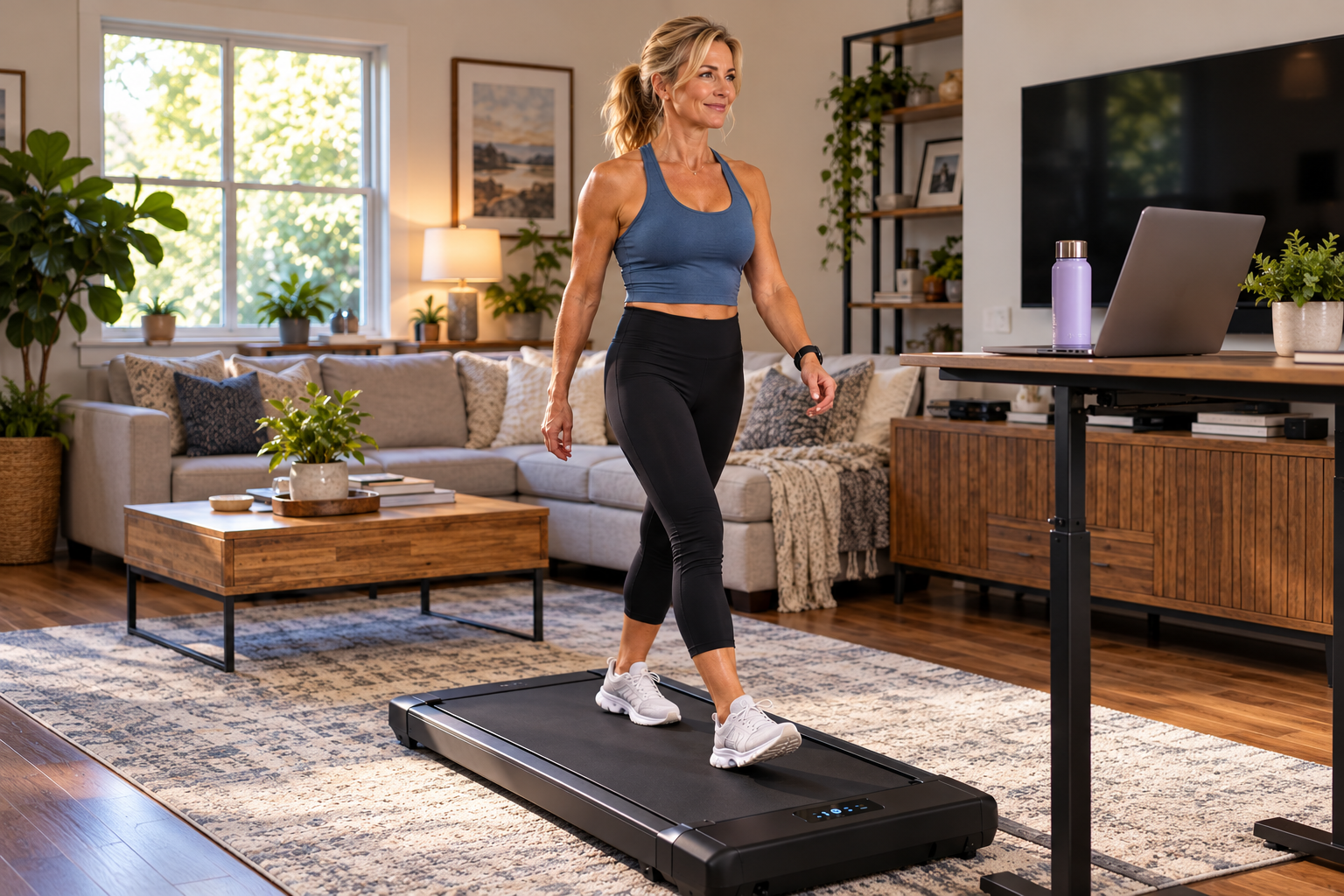
- Increasing heart-related measures starts with cardio. 30 minutes a day makes a world of difference, get your cardio in at-home with the Cardirun walking pad, a top-seller on Amazon Prime. Get yours here to get started.
Affiliate Disclosure: This page contains affiliate links. If you purchase through one of these links, we may earn a commission at no additional cost to you. We only recommend products and services we believe may provide value to our readers.
How to Prepare for a Safe, Repeatable Fitness Test
A chair that cannot slide and a clear patch of floor are more useful than any special equipment. Simple preparation makes a fitness test safer and helps you compare results over time.
Fitness assessments can cover aerobic fitness, muscular strength and endurance, flexibility, and body composition. Ask a health professional before testing if a medical condition, recent injury, or safety concern makes exertion uncertain. Warm up gently, and stop for pain, dizziness, unusual shortness of breath, or feeling unwell.
Stop if pain, dizziness, unusual shortness of breath, or feeling unwell occurs. Ask a health professional first when exertion may be unsafe.
Set up your space and record a baseline
Make your home testing area clear, bright, and free of loose rugs or objects. Keep a sturdy chair against a wall, so it cannot tip or slide. Gather a stopwatch, measuring tape, pen, and paper. A helper can count repetitions or record times while you focus on moving safely.
Use the same chair, route, footwear, and time of day when you repeat a check, when practical. Those details can affect a number even if your health fitness has not changed. Write down whether you used a wall, chair, or other support. A modification can make a test safer, but it may make scores less comparable with standard versions.
- Clear a nonslip space with room to move.
- Set a sturdy chair against a wall.
- Gather a stopwatch, measuring tape, pen, and paper.
- Ask a helper to count or record if useful.
Know when to pause or get help
Age alone does not tell you whether a test carries risk. Pay attention to how your body feels, and do not push through symptoms to finish a number. If your joints hurt or balance feels uncertain, make the movement easier or skip it. A safe, repeatable baseline is more useful than a score earned by forcing the effort.
Record the date and conditions, including any support or change you used. Then begin with the heart-rate check.
How to Check Your Resting Heart Rate at Home
A resting heart rate is the number of heartbeats per minute while you are calm and sitting or lying down. One quiet reading gives you a baseline, but it does not diagnose a health problem.
Rest your arm, then place two fingers on the thumb side of your wrist or the side of your neck. Feel for the pulse without pressing hard. Count the beats for 15 seconds and multiply by four to estimate beats per minute. For most adults, a healthy resting heart rate is 60-100 beats per minute.
A single reading can vary with recent activity, stress, or how you feel that day. If the number seems unusual for you, sit quietly and check again later. Note the time and circumstances, rather than treating one figure as a complete picture of heart health.
The target heart rate zone is a workout guide based on age and maximum heart rate. It ranges from 50%-85% of maximum heart rate, with 50%-70% for moderate activity and 70%-85% for vigorous activity. These examples show estimated zones:
| Age | Target heart rate zone (beats per minute) | Maximum heart rate (beats per minute) |
|---|---|---|
| 25 | 100-170 | 200 |
| 35 | 93-157 | 185 |
| 45 | 88-149 | 175 |
| 55 | 83-140 | 165 |
| 65 | 78-132 | 155 |
Age-based targets are estimates, not a required score. Your heart rate during exercise can help guide effort, but a target zone is not a diagnosis or a personal fitness grade. A resting pulse does not measure stamina by itself, so move on to a check that challenges aerobic fitness.
How to Test Aerobic Fitness With a One-Mile Walk
A brisk walk on a flat route can reveal more about stamina than a hard effort that forces you to stop. A controlled pace can help you check aerobic fitness while keeping the effort manageable.
The Rockport one-mile walk test uses a brisk, level one-mile walk. Record the time and your pulse after finishing. A field test estimates VO2 max; a lab test directly measures the body’s maximum oxygen use during intense exercise. VO2 max describes how much oxygen your body can use at that effort. A field estimate depends on more than time alone, including your pulse and other personal factors.
Try the one-mile walk
Choose a route that is flat, safe, and easy to measure. Walk briskly, but do not sprint or push until you need to stop. A friend can help track time and record your post-walk pulse. Keep the effort controlled throughout, then note how you felt as well as the numbers.
- Choose a safe, level route that measures one mile.
- Keep the effort brisk but controlled.
- Record your time and post-walk pulse.
Use a timed run only if it suits your fitness level
A timed 1.5-mile run or jog is another field check, but choose it only if you can do it comfortably. These reference times are for a run or jog, not targets for the Rockport walk:
| Age | Women’s 1.5-mile time (minutes) | Men’s 1.5-mile time (minutes) |
|---|---|---|
| 25 | 13 | 11 |
| 35 | 13.5 | 11.5 |
| 45 | 14 | 12 |
| 55 | 16 | 13 |
| 65 | 17.5 | 14 |
Age-based reference times cannot tell you everything about cardio fitness level by age. Do not use a run if your joints, symptoms, or current ability make it unsuitable. Repeat a field test on the same route and under similar conditions, then shift attention to lower-body strength.
What a 30-Second Chair Stand Says About Leg Strength
If getting up from a chair feels harder than it used to, this test can turn that everyday task into a simple strength check. The chair stand checks lower-body strength and endurance through a familiar movement.
Place a sturdy chair against a wall. Sit with your feet on the floor, then stand fully and sit back down with control. Repeat as many times as you can in 30 seconds. Use your hands for support if needed, and record that change because modified results are not directly comparable.
Before starting, make sure the chair cannot move and that you have room for your feet. Begin seated with your back upright and arms crossed over your chest if that feels safe. If you need to push from the chair or your thighs, do so rather than risking a fall. Record how you performed the test.
Move at a steady pace that lets you stand fully and sit with control. Do not drop into the seat or rush through repetitions. The number is a personal baseline, not a universal target for every age. A change over time may be more useful than comparing your count with someone else’s.
Stop if your knees, hips, or back hurt, or if your form becomes unsafe. If you feel unsteady, use support or skip the test. Strength affects more than exercise: the same movement helps you rise from a sofa, get out of a car, and stand from a low seat.
Write down your count and whether you used your hands. Note how controlled each repetition felt, then move to an upper-body test.
How to Check Upper-Body Strength With Push-Ups
Push-ups test more than arm strength when the body stays aligned through each repetition. Choose a version that lets you move with control, such as a wall push-up or a push-up from your knees.
For a wall version, place your hands at shoulder height and step back until your body forms a straight line. Bend your elbows to bring your chest toward the wall, then press away. For a knee version, keep your body aligned from shoulders to knees and your back straight. End the test when your form breaks or you need to rest.
Count only repetitions that feel controlled, and record which version you used. The reference counts below describe good-fitness push-up counts by age. They are comparisons, not a requirement or a direct measure of your overall fitness.
| Age | Women’s push-ups | Men’s push-ups |
|---|---|---|
| 25 | 20 | 28 |
| 35 | 19 | 21 |
| 45 | 14 | 16 |
| 55 | 10 | 12 |
| 65 | 10 | 10 |
If you are asking how a 2-minute push-up test measures fitness for your age, keep the timing difference in mind. This check counts repetitions with good form until rest is needed. Its number cannot be compared directly with a fixed-duration test, which counts repetitions during a set time.
A push-up should not cause sharp pain in your shoulders, wrists, elbows, or back. Change the angle or stop if discomfort starts. Good form matters more than chasing a higher count, and your next check can focus on the trunk muscles that support posture and movement.
How to Measure Core Strength With a Modified Plank
A plank that stays aligned for a short time is a clearer core check than a longer hold that strains the lower back. Control matters most when you test core strength.
Your core extends roughly from the lower rib cage to the buttocks. These muscles support the spine and hips during lifting, standing, and balance. Stop timing when you can no longer keep your back straight and your body aligned. A brief controlled hold tells you more than a sagging position held longer.
To try a modified plank, start on your hands and knees on a comfortable floor or mat. Lower onto your forearms, with your shoulders over your elbows. Keep your back straight and hips steady, then time a comfortable hold. Stop if your alignment changes or your lower back hurts.
A timer can help you record a baseline, but do not strain to reach an arbitrary number. If the position feels too demanding, shorten the hold or skip the check. The goal is to notice how well your trunk muscles support you, not to prove how long you can endure discomfort.
These exercises can help you practice gradually. Start with a small number of controlled repetitions or a brief hold, then build as it feels comfortable:
- Bridges: Lie on your back with knees bent, then raise your hips smoothly and lower them with control.
- Opposite arm-and-leg raises: From hands and knees, extend one arm and the opposite leg without twisting your hips.
- Modified planks: Hold a comfortable hands-and-knees position with a steady back, then stop before form changes.
Sit-ups and crunches can strain the neck and may emphasize the hip flexors instead of training the whole core. Choose movements that let you breathe and control your body. Trunk stability helps you stay steady while standing, so next check how you balance on one leg.
What a One-Leg Balance Test Can Tell You
A countertop within reach turns a balance check into a more controlled test. Stay close to support while you assess steadiness on each side.
Stand barefoot beside a wall or countertop, then lift one foot slightly. Start a timer and stop when your raised foot touches down or you need support. Repeat three times on each leg and record your best time for each side. Skip eyes-closed trials unless you have secure support and feel safe.
In adults ages 51-75, balancing on one foot for at least 10 seconds has been linked with lower mortality risk. That association does not prove what will happen to any one person. A balance score is a snapshot of your ability that day, not a prediction of lifespan or a diagnosis.
Measured age-related decline in one-leg balance averaged 1.7 seconds per decade on the dominant leg and 2.2 seconds per decade on the non-dominant leg. Those figures describe an average, not a deadline for you. Age, health, footwear, and the testing surface can all affect a result.
Use a firm, uncluttered floor and keep your hand near support. Do not test with your eyes closed if you are alone or feel at risk of falling. If you feel unsteady, stop and use the counter. Prioritize steadiness over a longer time, then move to range of motion.
How a Sit-and-Reach Check Can Assess Flexibility
Reaching toward a foot can show how comfortable a familiar bending movement feels today. A gentle reach offers a simple look at flexibility and joint range, not a diagnosis.
Sit on the floor with one leg extended and the other comfortably bent. Reach toward the extended foot without bouncing, and notice where your fingertips fall. Stop before pain or a sharp pulling feeling begins. You do not need to force your body toward the toes.
If sitting on the floor is uncomfortable or difficult, try a chair-based version. Sit near the front of a sturdy chair, extend one leg with the heel on the floor, and reach gently toward that foot. Keep your movement slow, and stop if your back, knees, or other joints hurt.
Your result depends partly on limb proportions, joint comfort, and how your body feels that day. A longer reach does not automatically mean better fitness, and there is no single score that defines your range. Record the position you used so you can make a fair comparison later.
Gentle movement may help you notice stiffness, but a reach cannot explain its cause. Avoid bouncing or pulling hard to improve a number. Flexibility is one piece of the picture, so consider it alongside your strength, stamina, balance, and other checks.
Senior Fitness, Fitness Over 50, Core Strength, VO2 Max Test, Fitness Over 60: How to Read Your Results
One strong score beside one challenging score is a reason to set a specific goal, not to label yourself unfit. Your own baseline is the most useful point of comparison.
Look at how your results change over time, and consider your age, symptoms, mobility, and any test modifications. A fitness-by-age calculator or quiz-style self-check cannot replace an assessment by a health professional. A fit and healthy after 50 quiz or fitness tests for longevity can prompt questions, but neither gives a complete view of your health.
Compare your scores with your own baseline
Different checks measure different abilities, so mixed results are expected. A higher number in one area does not cancel a lower one elsewhere. If a test felt harder because you used support or changed the movement, record that detail rather than treating the score as directly comparable.
Use each result to identify a practical area to work on. If stamina is your focus, note how a walk feels and how long it takes. If core strength or balance is more important, track the same safe version each time. A calculator can help you organize information, but it cannot account for every health concern or symptom.
Treat body-composition numbers as context, not a fitness grade
BMI and waist measurements describe body composition and possible health risk. They do not directly measure muscular strength or aerobic fitness. BMI is calculated by dividing weight in pounds by height in inches squared, then multiplying by 703. In metric units, divide weight in kilograms by height in meters squared.
| BMI | Category | Interpretation |
|---|---|---|
| Below 18.5 | Underweight | Below the standard adult range |
| 18.5-24.9 | Normal weight | Within the standard adult range |
| 25.0-29.9 | Overweight | Above the standard adult range |
| 30 or above | Obesity | At or above the standard adult range |
A waist circumference greater than hip circumference means more weight is carried above the hips and is associated with higher risk of heart disease and type 2 diabetes. Waist measurements of 35 inches (89 cm) or more for women and 40 inches (102 cm) or more for men are also associated with higher risk. Neither measure diagnoses disease.
Numbers are context, not a verdict on your health or ability. Turn the most useful finding into a manageable activity goal, then build toward it gradually.
How to Improve Your Scores and Retest
A small amount of regular activity is a more sustainable starting point than trying to improve every score at once. Build gradually and choose movement that fits your current ability.
For most healthy adults, weekly guidance is at least 150 minutes of moderate aerobic activity or 75 minutes of vigorous aerobic activity, or an equivalent mix. Strength training should work all major muscle groups at least twice a week. Choose a resistance level that tires your muscles after about 12-15 repetitions.
Start with manageable movement and increase it gradually. Strength work should challenge your muscles while allowing safe form.
Build strength and aerobic activity gradually
You can split aerobic activity into shorter sessions and build up as you feel able. Walking, water aerobics, or gardening can fit a moderate effort. Vigorous activity might include running, swimming laps, or fast cycling, if it suits your health and ability.
| Activity type | Weekly target | Examples |
|---|---|---|
| Moderate aerobic activity | At least 150 minutes | Brisk walking, water aerobics, gardening |
| Vigorous aerobic activity | At least 75 minutes | Running, swimming laps, fast cycling |
| Strength training | At least twice weekly | Weights, resistance bands, body-weight exercises |
Adapt exercises to your range of motion, symptoms, and access to equipment. Rest 24-48 hours between demanding strength sessions for the same muscle groups. Safe technique matters more than finishing a set through pain or losing control.
Repeat the same checks under similar conditions
Use the same version, route, chair, and recording method when you retest. That makes it easier to see a real change rather than a difference in setup. Repeat the same measurements about six weeks after starting an exercise program, then check progress occasionally.
- Schedule manageable movement you can repeat.
- Practice strength exercises with safe form.
- Record activity and progress in a simple log.
Begin with one change that feels realistic this week. Gradual progress gives you a clear personal next step without asking you to improve every score at once.
Conclusion
The most useful fitness score is the one that helps you choose a safe next step. Pick one result to work on, and record it consistently so you can see your own progress.
Choose an activity that fits your ability and schedule, then note when you begin. After about six weeks, repeat the same check under similar conditions. The number does not need to rise quickly to show that you are building a habit.
Start with one manageable activity, keep track of your progress, and adjust the goal as your comfort and ability change.
FAQ
How to increase VO2 max at age 60?
You can build VO2 max by adding regular aerobic activity gradually, such as brisk walking, cycling, or swimming. Start at a pace you can sustain and increase duration or effort over time. If you have a health condition or symptoms, ask a health professional before adding vigorous intervals. Consistency and safe progression matter more than making each workout intense.
What is the chair stand test for senior citizens?
The chair stand test counts how many times you can sit down and stand up from a sturdy chair in 30 seconds. Keep the chair against a wall, use controlled movements, and record your repetitions. You can use your hands for support if needed, but note that modification because it changes how your result compares with other scores.
How in shape am I?
Use several checks together to get a broad baseline across stamina, strength, balance, and flexibility. Your results can show areas that feel comfortable and areas you may want to work on. One score is not a diagnosis or a complete health assessment. Compare your checks with your own earlier results and consider how you felt during each test.
Can an 80 year old regain strength?
Yes, strength can improve at any age with gradual resistance exercise suited to the person. A safe starting point may use a light resistance band, a chair-supported movement, or a few body-weight repetitions. Health conditions, past injuries, and current ability affect the right starting level. Professional guidance can help when safety or exertion is uncertain.
How much should a 75 year old man be able to bench press?
There is no single required bench-press number for every 75-year-old man. Strength, lifting experience, health, range of motion, and safe technique all affect what is appropriate. A person new to lifting should begin with light resistance and controlled form, not a maximum-effort attempt. A personal baseline and gradual progress are more useful than a universal target.
Leave a Reply